When sea food edged out catch from river
Account subscription benefits alongside Premium Stories, Editorials, Opinions and more. Unlock these with Subscription
A community leader says encroachments, pollution, and lack of desilting of rivers have made them mere sewage carriers and garbage bins. | Photo Credit: B. JOTHI RAMALINGAM
Until about four decades ago, people in Madras bought and consumed madava, keluthi, ooda, era, and nandu freshly caught from the city’s rivers and estuaries. You could hear fish mongers hawking out aloud “meen, ma, meen” urging the women of the houses to come out and buy. They would walk around residential localities, seeking prospective buyers.
Pattinampakkam, Adyar, Kotturpuram, and Saidapet were excellent hunting grounds for inland fishermen. Using small nets and catamarans (wooden logs held together by ropes), they would fish in the pristine waters and slush near the river mouths, happy with a small catch, said Krishnamohan, a former Fisheries Department staffer.
The few remaining inland fishermen have registered themselves as sea-faring fishermen, and fish in the Adyar only when it rains. | Photo Credit: B. JOTHI RAMALINGAM
“We had very vibrant inland fishermen cooperative societies. But encroachments, pollution, and lack of desilting of rivers have led to them becoming mere sewage carriers and garbage bins. Various insects that were fish feed would grow in the slush. But now, even those have vanished. The few remaining inland fishermen have registered themselves as sea-faring fishermen, and fish in the Adyar only when it rains. During the Northeast monsoon, on some days, one can see inland fishermen casting lines from Adyar and Kotturpuram bridges,” said M.D. Dayalan, a fishing community leader.
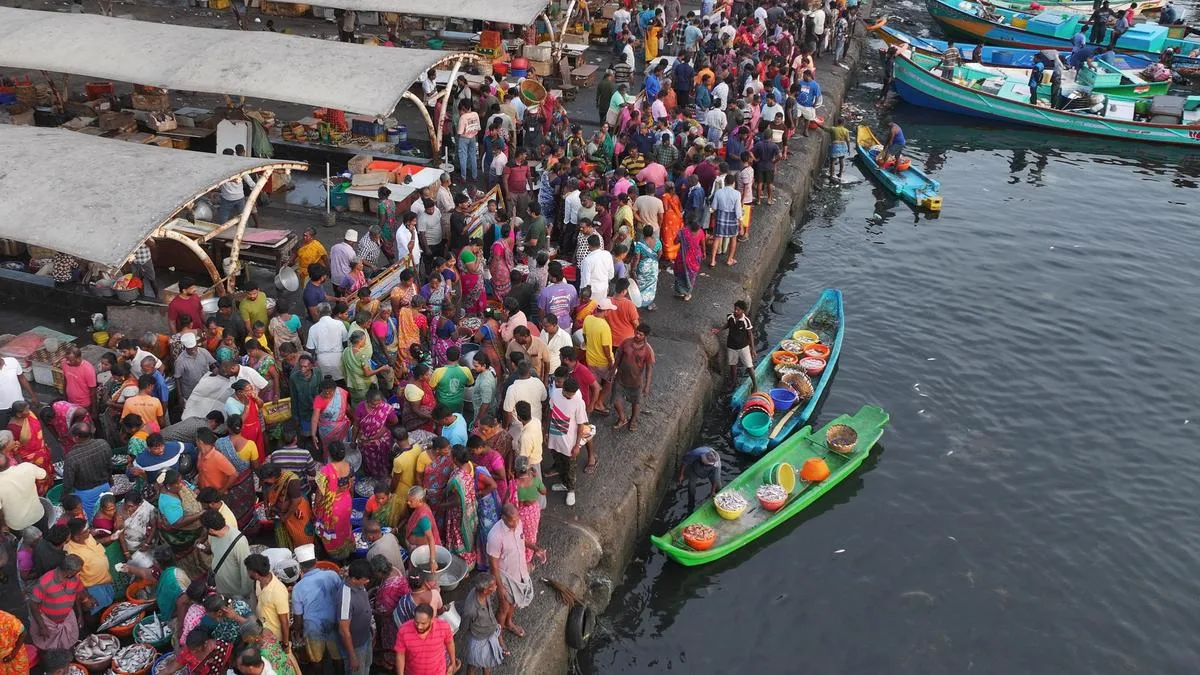
Nowadays, inland fish are caught in reservoirs and lakes around the city and sold to those who want these varieties. Similarly, over the years, fish from the sea has become favourites among residents. From Ennore, which is ward 1 of the Greater Chennai Corporation to Nainarkuppam in ward 200, there are over tens of fishing hamlets all along the coastline. In 2022-23, the fishermen’s catch amounted to 52,134 tonnes. The Kasimedu Fishing Harbour in Royapuram in north Chennai, is now home to around 900 mechanised boats and hundreds of smaller vessels.
The Kasimedu Fishing Harbour in Royapuram in north Chennai, is now home to around 900 mechanised boats and hundreds of smaller vessels. | Photo Credit: B. JOTHI RAMALINGAM
M.E. Raghupathi, another fishing community leader, said wooden catamarans were slowly replaced as the traditional craft were not very sturdy in the sea. “Their ropes would get undone and the fish and nets that they carried would be lost at sea. In 1990, the first fiberglass reinforced plastic (FRP) boat was introduced. The government too gave subsidies for these boats to ensure safety of the fishermen. We now have FRP boats that are around 65 feet long with double engines and can stay in the high seas for a week.”
However, in many fishing hamlets, the fishing community feels that it is being treated as second-class citizens. “This is the oldest of professions known to man. We don’t get good rates for our catch.
5News aggregated this summary from the outlet’s public feed. The full article, with all the context, is on www.thehindu.com — the content belongs to The Hindu - National.