BMRCL could have earned ₹103.77 crore more from Nagasandra property: CAG
Account subscription benefits alongside Premium Stories, Editorials, Opinions and more. Unlock these with Subscription
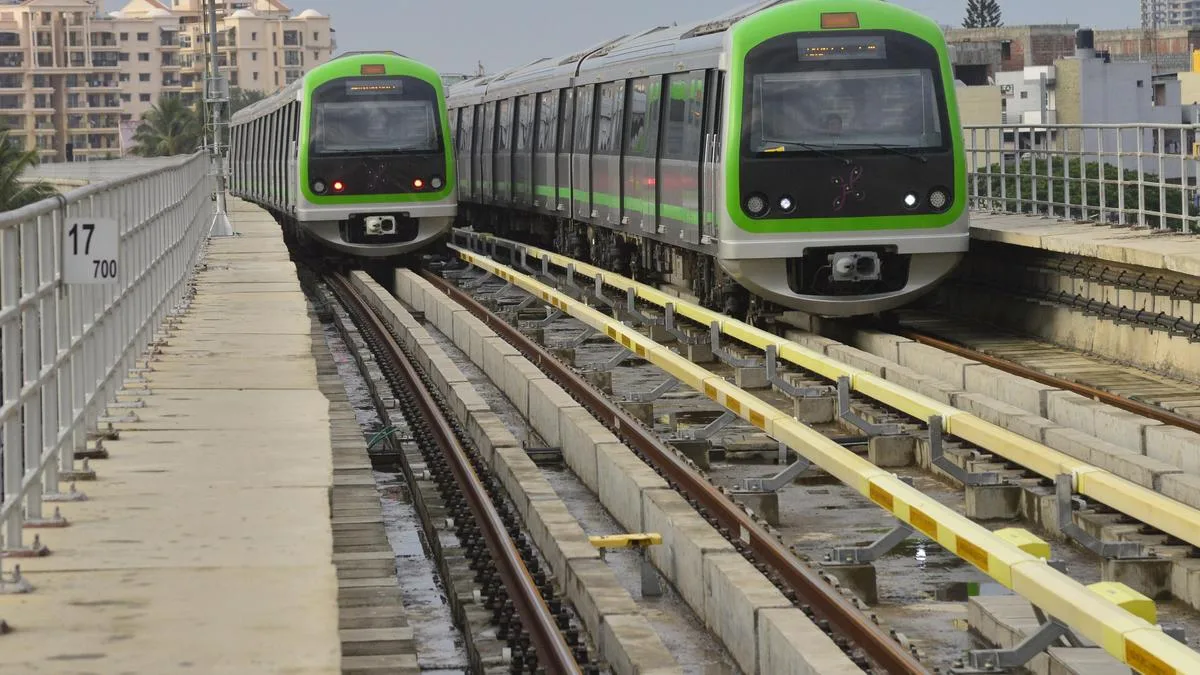
Green Line trains. Among other things, the CAG noted that there was no approved policy for securing innovative financing of metro stations and corridors in a transparent and competitive manner. | Photo Credit: K Murali Kumar
The Bengaluru Metro Rail Corporation Limited (BMRCL) lost potential revenue of ₹103.77 crore by fixing the minimum development premium at a lower level while leasing 14 acres of land for integrated property development near Nagasandra station, the Comptroller and Auditor General of India (CAG) has said.
The CAG, in its performance audit of the implementation of Phase 1 and Phase 2 of the Namma Metro rail project, found that BMRCL did not adequately safeguard its financial interests while determining the premium for the property.
According to the report, a consultant had initially assessed the development premium at ₹320 crore in March 2015. However, the estimate was subsequently revised and the minimum development premium was fixed at ₹240 crore. The land was eventually leased for ₹251.01 crore, with an annual charge of ₹2.51 crore and a 5% escalation from December 2023.
The audit found that, based on the prevailing guidance value and the valuation criteria applicable at the time, the potential value of the property could have been as high as ₹354.78 crore. CAG, therefore, calculated the potential revenue foregone at ₹103.77 crore.
The Nagasandra case was part of a wider concern raised by the audit over BMRCL’s ability to generate non-fare box revenue through property development. For Phase 2, financial viability calculations had projected income of ₹21,282 crore from property development on an additional 55 hectares between 2016-17 and 2041-42. However, the 55 hectares earmarked for property development had not been acquired as of March 2023.
The audit also found that BMRCL had developed 2.46 lakh square feet of built-up space at metro stations for property development, but only 0.23 lakh square feet was being utilised for commercial activity. The remaining 2.23 lakh square feet had remained vacant for years.
This resulted in an estimated loss of ₹38.53 crore in potential lease revenue during 2019-22. CAG also noted that BMRCL did not have an Asset Management Policy to guide the monetisation of vacant spaces.
According to the audit, BMRCL had subsequently floated tenders for retail space at 220 locations across 56 metro stations, with expected revenue of ₹25 crore, and had finalised an Asset Management Policy for approval.
The shortcomings in property development assume significance given the scale of investment in the metro project. BMRCL and the State and Union governments had invested about ₹40,000 crore in Phase 1 and Phase 2 as of March 2023, but the audit found that the principles of Value Capture Financing had not been deployed to generate revenue from the increase in land values created by metro infrastructure.
BMRCL had entered into six memoranda of understanding valued at ₹605 crore for innovative financing of metro stations and corridors.
5News aggregated this summary from the outlet’s public feed. The full article, with all the context, is on www.thehindu.com — the content belongs to The Hindu.