New UPI MDR rules explained: Will you pay more? What it means for users like you and me
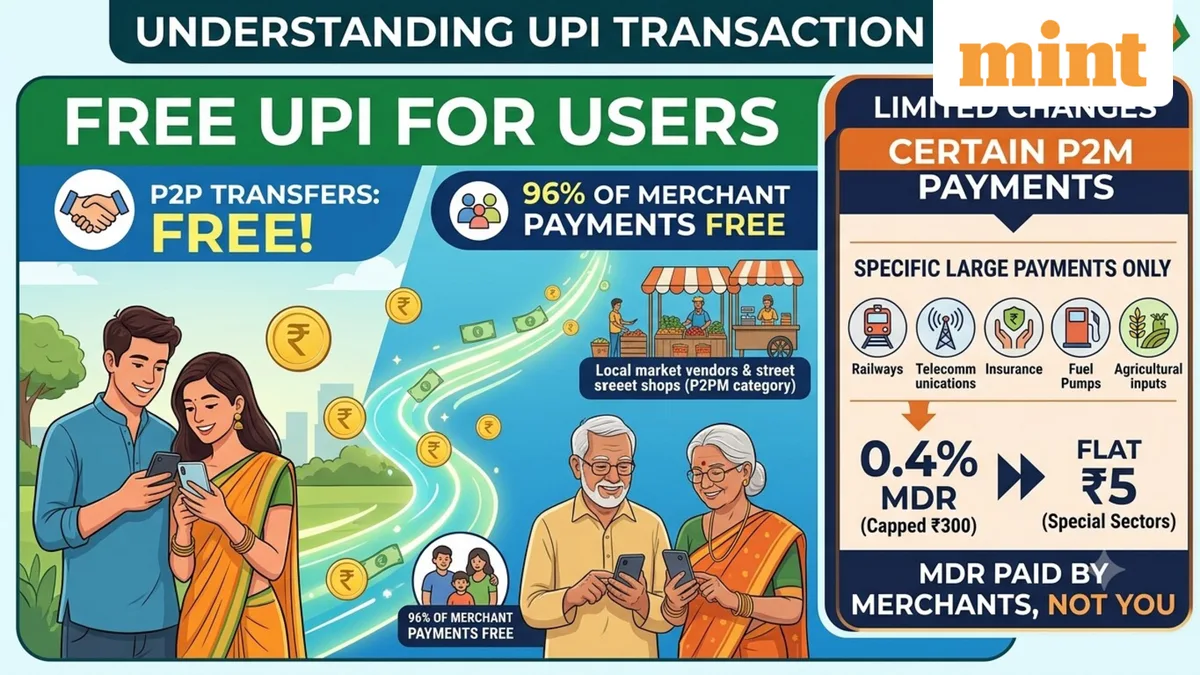
UPI users will continue to send and receive money without paying transaction charges under the new merchant discount rate (MDR) framework. The changes apply only to certain merchant payments, while person-to-person (P2P) UPI transactions remain completely free, regardless of the amount.
The framework is intended to create a revenue stream for the digital payments ecosystem while protecting individuals and small merchants from additional costs. Around 96% of merchant transactions are also expected to remain unaffected.
No. All P2P UPI transactions will remain free . Users will not be charged a transaction fee, platform fee or other cost for sending or receiving money, regardless of the amount.
P2P transactions account for about 70% of UPI's total transaction value and remain outside the MDR framework.
There will also be no monthly quotas or tiered caps on free UPI usage. Daily transaction limits set by banks and NPCI are security and risk-management measures, not charging thresholds.
So, whether you are sending money to a friend, transferring funds to a family member or moving money between your own accounts, the new MDR framework does not introduce a fee.
For person-to-merchant (P2M) transactions, payments of up to ₹ 2,000 will remain free of MDR.
Eligible small merchants will also continue to benefit from zero MDR. Small businesses, including street vendors and neighbourhood shops, receiving up to ₹ 1 lakh a month through UPI QR codes under the P2PM category will remain protected from MDR.
A 0.4% MDR will apply to specified P2M transactions above ₹ 2,000. For transactions of ₹ 75,000 and above, the MDR will be capped at ₹ 300 per transaction.
MDR is not a tax and is not collected by the government or NPCI. It is distributed among participants in the payment ecosystem, including banks, payment service providers and UPI application providers.
Crucially, customers will not pay MDR. Banks have been advised to ensure merchants do not pass the cost on to customers, while UPI application providers cannot impose platform fees or hidden charges.
Transactions above ₹ 2,000 in essential and thin-margin sectors such as railways, telecommunications, insurance, fuel and agricultural inputs will attract a flat MDR of ₹ 5.
Capital-market transactions involving mutual funds, securities, stockbrokers and dealers will attract an MDR of 0.02%, capped at ₹ 300.
The framework estimates that MDR will apply to only about 4% of merchant transactions. Consequently, approximately 96% of merchant transactions will remain unaffected.
5News aggregated this summary from the outlet’s public feed. The full article, with all the context, is on www.livemint.com — the content belongs to LiveMint - Money.