Delhi protest crackdown: Supreme Court says right to peaceful protest constitutionally protected, mulls framing guidelines
Account subscription benefits alongside Premium Stories, Editorials, Opinions and more. Unlock these with Subscription
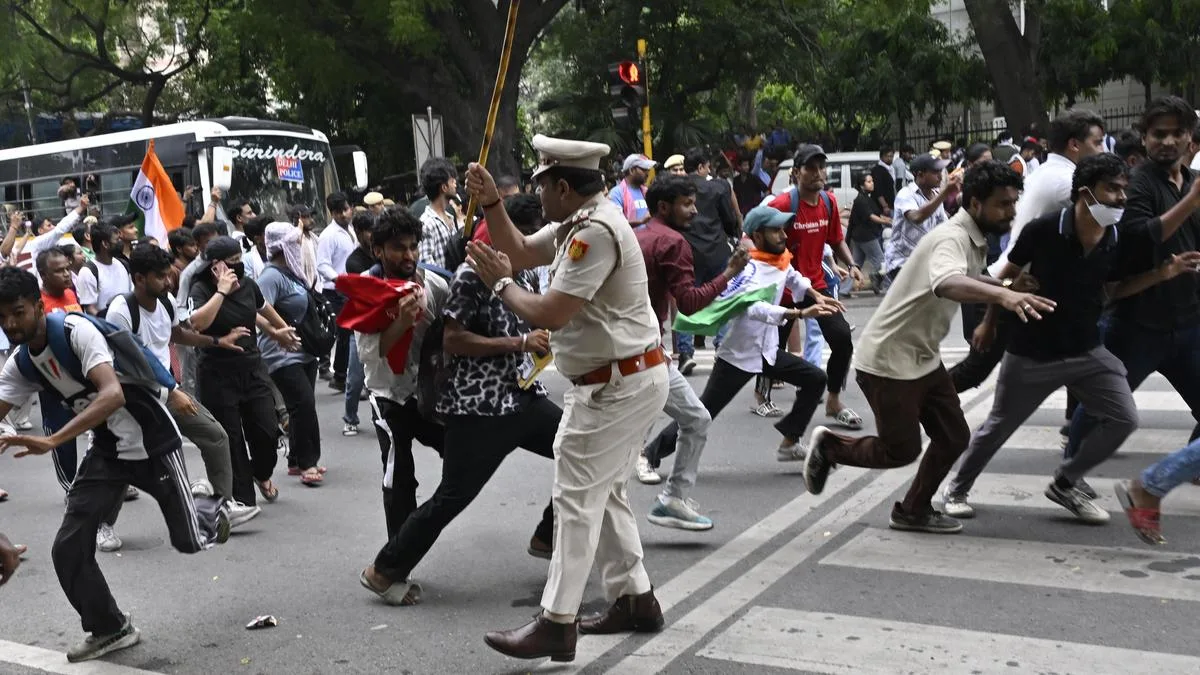
Police personnel using lathi charge to disperse supporters of the Cockroach Janta Party (CJP) during a protest march to demanding the resignation of Education Minister Dharmendra Pradhan over alleged NEET exam irregularities, near Parliament House, in New Delhi on July 20, 2026. | Photo Credit: SHIV KUMAR PUSHPAKAR
The Supreme Court on Monday (July 27, 2026) observed that the constitutional right to peaceful protest must be protected and indicated that it may consider framing uniform guidelines to regulate police conduct during large-scale demonstrations.
A Bench led by Chief Justice of India (CJI) Surya Kant said it was equally concerned about injuries suffered by both protesters and police personnel during such protests, and stressed that “self-imposed discipline” on the part of both citizens and law enforcement was essential to the functioning of a democracy.
NEET-UG protests case: Petitioners seek re-constitution of high-powered enquiry committee
“The right to peaceful protest is absolutely guaranteed under the Constitution. So long as it is a peaceful agitation, merely because there is agitation, there cannot be [police excesses]... If there is police excess committed, it should be independently examined. Merely because there is agitation, it does not mean there should be a lathi charge. Discipline is integral to the democratic process,” the Chief Justice orally remarked.
The oral observations came as multiple petitions concerning the nationwide protests over examination paper leaks were mentioned before the Bench, which also comprised Justices Joymalya Bagchi and V. Mohana. These included petitions alleging police excesses during the July 20 Parliament march led by the Cockroach Janta Party (CJP), as well as those concerning the alleged “aerial firing” by police personnel in Bihar’s Siwan during the Bihar bandh on Saturday (July 25, 2026), called by the All India Students’ Association (AISA) over the NEET paper leak.
Following the protests, which spread across several States and snowballed into a major political crisis for the Narendra Modi government, Dharmendra Pradhan resigned as the Union Education Minister on Saturday (July 25, 2026). Union Minister Pralhad Joshi assumed charge as the new Education Minister on Sunday (July 26, 2026). Meanwhile, in a move to strengthen the anti-cheating law, the Union government proposed the Public Examinations (Prevention of Unfair Means) Amendment Bill, 2026 , which seeks to increase the punishment for those involved in unfair means, including the leaking of question papers for public examinations, from three to five years’ imprisonment to five to 10 years. It also proposes to enhance the maximum fine from ₹10 lakh to ₹50 lakh.
5News aggregated this summary from the outlet’s public feed. The full article, with all the context, is on www.thehindu.com — the content belongs to The Hindu - National.