Transaction records alone can’t prove genuine share gains: Why ITAT upheld ₹14.85 lakh tax addition
An Ahmedabad taxpayer’s claim of capital gains from shares of Kushal Tradelink Ltd. has been rejected by the Income Tax Appellate Tribunal, despite the taxpayer producing contract notes, broker statements, demat records and bank statements to support the transactions.
The Ahmedabad ITAT, in Manishkumar Ramlakhan Agrawal vs Income Tax Officer, Ward 6(1)(1), Ahmedabad , ITA No. 919/Ahd/2025 for assessment year 2018-19, upheld an addition of ₹ 14.85 lakh as unexplained money under section 69A of the Income-tax Act. The order also directed the tax authorities to reconsider a separate dispute relating to the taxpayer’s long-term capital loss.
The case is relevant for investors because the tribunal’s reasoning shows that having a conventional documentary trail for a share transaction may not, by itself, establish that the resulting gains are genuine when tax authorities have other material pointing towards an accommodation-entry arrangement.
The taxpayer had reported long-term capital gains of ₹ 7.86 lakh and short-term capital gains of about ₹ 6.02 lakh in his return for assessment year 2018-19. The transactions involved shares of Kushal Tradelink.
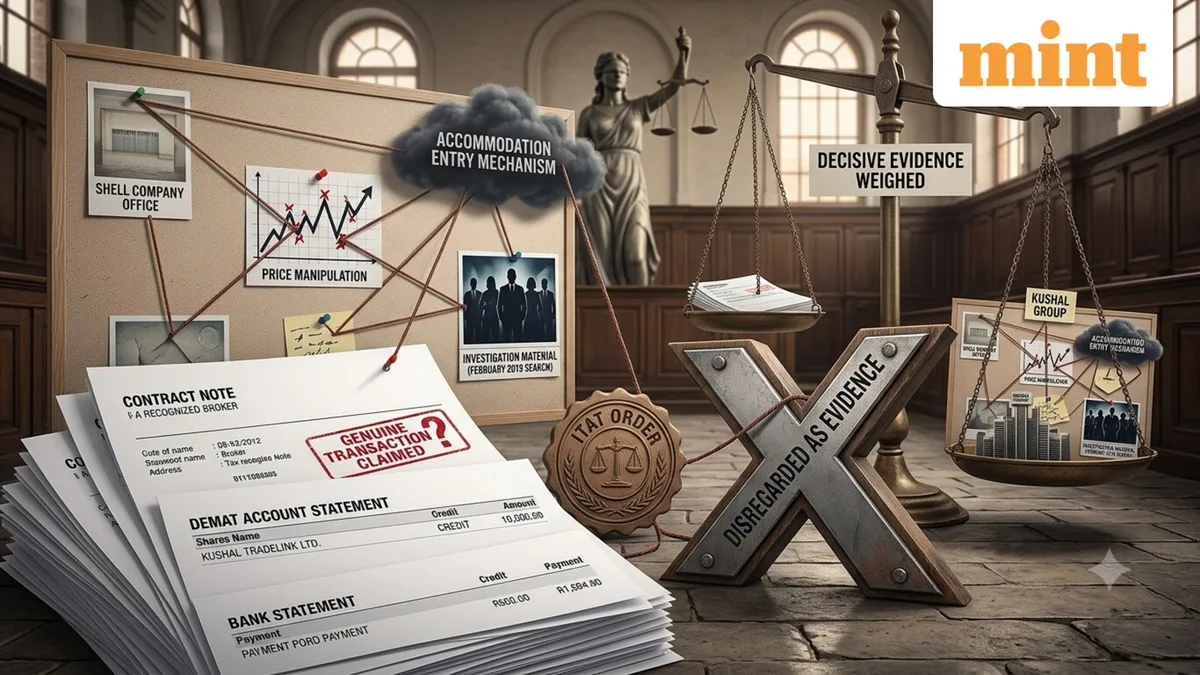
The taxpayer argued that the transactions were genuine because the shares had been purchased and sold through the recognised stock market and a SEBI-registered broker. The transactions were supported by contract notes, broker statements, demat-account records and bank statements. The shares were credited to the demat account and the payments were routed through banking channels.
The tax department, however, had relied on information gathered during a search of the Kushal Group in February 2019. According to the assessment proceedings, the investigation had identified alleged price manipulation and accommodation entries involving the group’s companies.
The assessing officer treated the entire transaction value of ₹ 14.85 lakh as unexplained money under section 69A, rather than accepting the taxpayer’s claim that the amount represented genuine capital gains.
The ITAT noted that the existence of stock-exchange transactions, banking records and demat entries could not be considered in isolation. It followed an earlier coordinate-bench decision concerning transactions involving the same group and found no basis to take a different view in the taxpayer’s case.
In effect, the tribunal considered the surrounding circumstances and investigation material alongside the taxpayer’s documents. The order therefore does not establish that demat records or bank statements are insufficient in ordinary circumstances. Rather, it shows that such records may not conclusively establish genuineness where there is other material connecting the scrip to an alleged accommodation-entry mechanism.
The ruling also dealt with a separate issue concerning the taxpayer’s long-term capital loss.
The taxpayer had claimed a long-term capital loss of ₹ 40.74 lakh, but the amount allowed by the tax authorities was restricted to ₹ 18.30 lakh. The taxpayer challenged this before the appellate authorities.
The ITAT found that the Commissioner of Income Tax (Appeals) had not properly adjudicated this particular ground.
5News aggregated this summary from the outlet’s public feed. The full article, with all the context, is on www.livemint.com — the content belongs to LiveMint - Money.