The science of Gaganyaan parachutes | Explained
Account subscription benefits alongside Premium Stories, Editorials, Opinions and more. Unlock these with Subscription
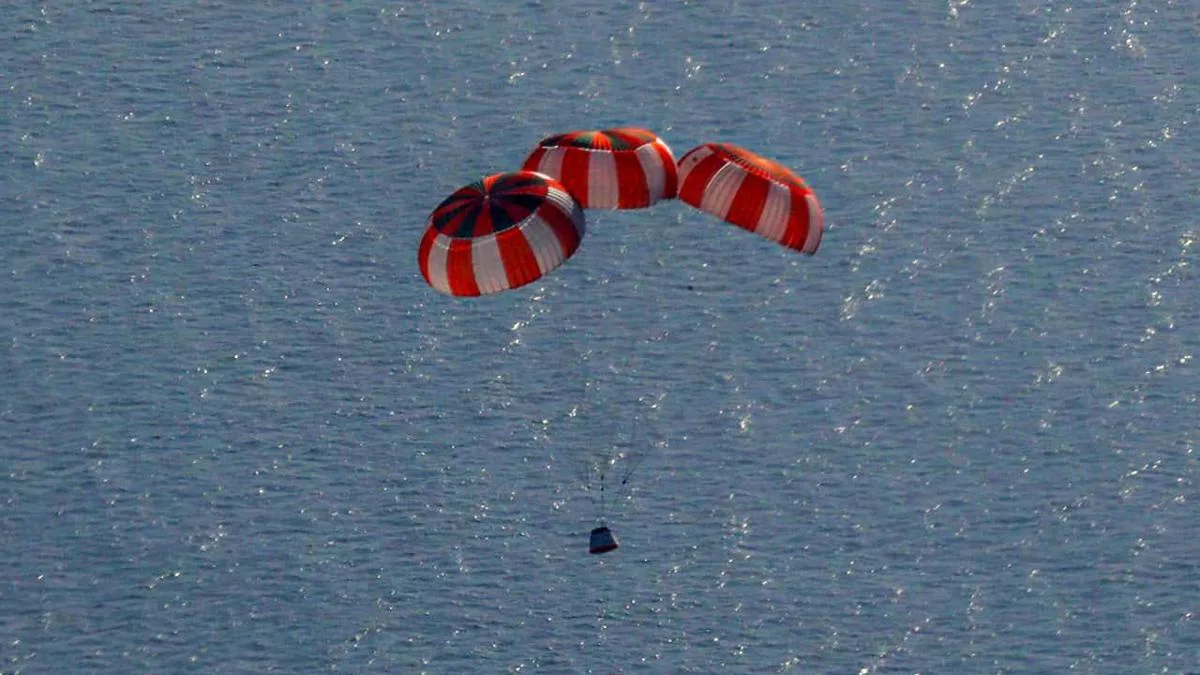
The Gaganyaan crew module has two drogue chutes deployed by mortars and three main chutes deployed by mortar-ejected pilot chutes | Photo Credit: ANI
Any spacecraft entering the earth’s atmosphere will rely primarily on atmospheric drag to reduce a significant portion of its velocity as it aerobrakes.
Towards the terminal phase, to gently touchdown on land or in sea, additional decelerating systems like parachutes have to be activated to further reduce its velocity to acceptable limits.
The parachute used for crewed space vehicles demands extraordinary engineering with multi-staging, redundancy, high-performance materials and high-pressure packing for reducing the storage space.
Generally, the parachute system contains three types of chutes: pilot, drogue, and main. The pilot chute is a mini-parachute deployed to pull out larger diameter drogue or main chutes. The drogue chute is deployed early in the descent to stabilise the module and first reduce the velocity. The main chute has a wider canopy and is used in the final phase to reduce the velocity enough to achieve gentle soft-landing conditions.
The blunt shape of the crew module creates a turbulent wake in its rear side and the parachute has to be ejected through this wake. The ejection mechanism should ensure that the energy imparted to the parachute is sufficient enough to cross the wake in the shortest time and deploy the parachute in the far-wake region behind the module. Some of the conventional deployment methods used are as follows:
Generally, the parachute deployment takes place when the module has reduced its speed to sub-sonic condition (lower than the speed of sound. At supersonic speeds, standard canopies get shredded due to shockwave interaction and intense dynamic pressure.
The Gaganyaan crew module returning from orbit would be having a high velocity of about 170 m/s ( faster than a Formula 1 car) when it is in the lower atmosphere. If the full-sized main parachute is directly deployed, it would generate very high opening shock levels which will either lead to shredding of parachute canopy fabric or subject the crew to unacceptably high deceleration levels.
The solution is to go for multi-stage release of parachutes wherein the diameter of the chute will be increased in successive stages for reducing the deceleration and dynamic pressure to acceptable levels.
If a large Main parachute opened fully all at once at high speed, the instantaneous large force would destroy the canopy fabric and exert lethal deceleration forces on the crew. To prevent this, the parachute canopy mouth is allowed to open only in steps. The process is analogous to gradually opening an umbrella in strong winds. If you pop it open all at once, the wind will likely snap the umbrella.
For the parachute, a strong cord is taken through the skirt around the canopy and the length of the cord decides what percentage area of the parachute canopy should open in the first step.
5News aggregated this summary from the outlet’s public feed. The full article, with all the context, is on www.thehindu.com — the content belongs to The Hindu - Sci-Tech.