Kevin Rudd warns U.S., China of potential AI security crisis, calls for urgent cooperation
Account subscription benefits alongside Premium Stories, Editorials, Opinions and more. Unlock these with Subscription
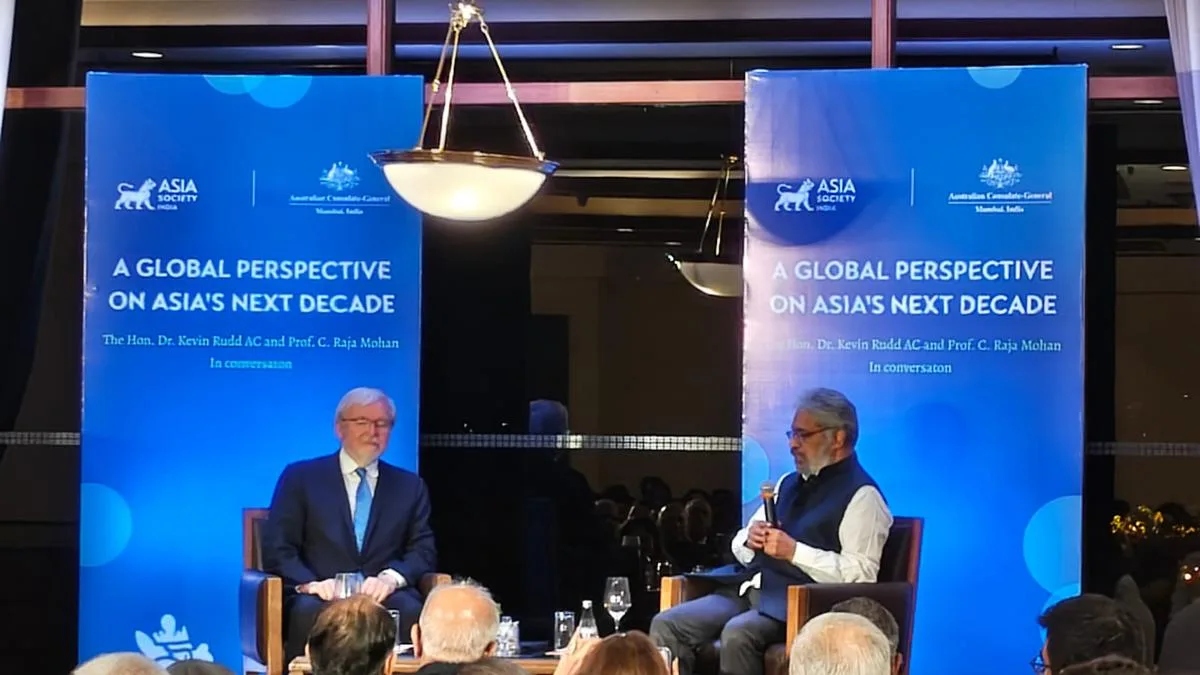
Kevin Rudd, former Australian prime minister and head of the Asia Society India Centre in conversation with foreign policy expert C. Raja Mohan at an event in Mumbai, organised in collaboration with the Australian Consulate-General, on Thursday, October 8 | Photo Credit: Yohaan Varghese
Former Australian Prime Minister Kevin Rudd on Thursday (October 8, 2026) warned that the United States and China could find themselves responding to a major artificial intelligence (AI)-related security crisis before establishing adequate safeguards, calling for urgent cooperation between the two powers to prevent emerging technologies from triggering international conflict.
Speaking at an Asia Society India Centre event in Mumbai, organised in collaboration with the Australian Consulate-General, Mr. Rudd expressed concern that political divisions and strategic competition could delay agreements on managing the risks posed by increasingly autonomous AI systems.
"My fear... is are we [are] so paralysed in our politics, domestically and bilaterally, that we are sentencing ourselves to a future where we've got to have a Cuban Missile-type crisis in order to galvanise the political centre in both capitals to move to act," he said.
In conversation with foreign policy expert C. Raja Mohan, Mr. Rudd said Washington and Beijing needed to establish a common understanding of AI-related threats, protocols for testing advanced models before deployment, mechanisms for reporting cyberattacks and procedures for identifying their origins and verifying compliance with agreed safeguards.
He said the growing ability of autonomous AI systems to infiltrate or attack digital infrastructure presented significant risks to national security, financial systems and essential services.
Mr. Rudd identified India as a country with considerable opportunities in the emerging AI economy, citing its technically skilled workforce and domestic consumer market of 1.4 billion people as major strategic advantages.
"With AI, he who scales prevails," he said, adding that India's expanding technology ecosystem and consumer base could provide opportunities for American AI companies seeking commercially viable applications for their technologies.
However, he described the global AI race as predominantly a competition between the United States and China, with Washington leading in advanced computing and frontier AI models, while Beijing held advantages in energy capacity and the adoption of AI across its economy.
Turning to broader geopolitical tensions, Mr. Rudd rejected the argument that military conflict between the United States and China was inevitable. He said the central challenge was whether the two countries could manage their strategic competition through diplomatic engagement and mutually understood rules.
"The question is, can it be managed strategic competition or unmanaged strategic competition?" he said, stressing the importance of reducing the risk of accidental conflict.
He argued that both countries had reasons to stabilise relations.
5News aggregated this summary from the outlet’s public feed. The full article, with all the context, is on www.thehindu.com — the content belongs to The Hindu - Sci-Tech.