Time-lapse footage shows just how fast rebuilding in Kumamoto can go
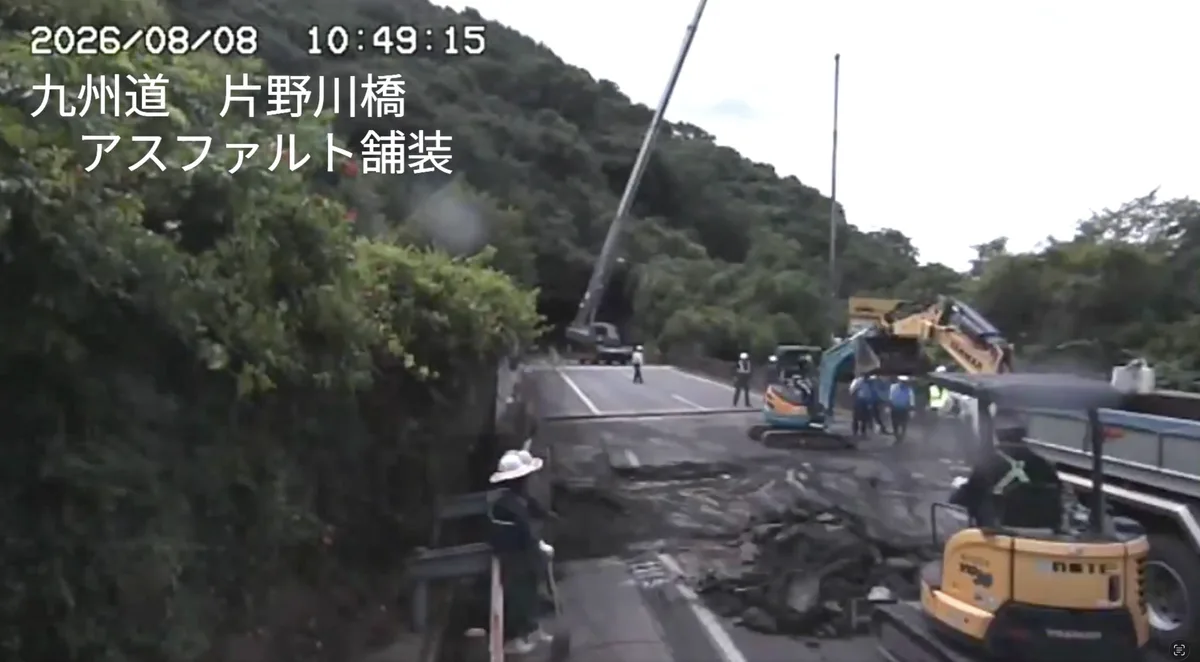
All in a day’s work .
Whenever major natural disasters hit Japan, I’m always amazed by the engineering feats that were set up in various places to minimize casualties and damage.
It’s hard to feel a sense of joy or pride at times like the 7.1 magnitude earthquake that hit Kumamoto recently , but at the same time it feels like a lot of hard work and ingenuity that goes into damage prevention often gets overlooked.
One prime example I noticed in the immediate aftermath was scenes of elevated highways sheared into two completely disjoined sections.
It was constantly played on a loop as a symbol of the catastrophic power of the earthquake without any explanation as to why the roads looked like that. ▼ It was basically the exploded AEON Mall, broken smokestack, and broken highway, over and over again for the first day.
The highways were designed to break like that in the event of an earthquake to prevent even bigger devastation.
If the entire overpass was one solid unit, one weakened section would cause the entire structure to fall down, as happened in the 1995 Awaji-Hanshin earthquake. ▼ A news report in the aftermath of the Hanshin-Awaji Earthquake showing the massive destruction of elevated expressways.
In the latter part, Prof.
Fukuwa explains that the flaw in the design was using combinations of materials that vibrated at different frequencies together in a rigid structure.
The news footage seldom, if ever, showed what was going on underneath those detached segments, which is where the real magic happens.
Systems can vary as needed, but often these cables, rods, and stoppers not only reduce overall damage but make repairs easier and faster. ▼ This video is in Japanese, but the images alone should demonstrate how well-thought-out these mechanisms are, built on lessons learned from past disasters.
And speaking of fast repairs, with earthquakes an ever-present threat, crews are well-trained to react to damage quickly and thoroughly.
A good example of this can be seen in a time-lapse video of a highway repair in Kumamoto done by workers for NEXCO , Japan’s privatized company that manages the nation’s expressways. ▼ “We are currently doing reconstruction work on the southbound/outbound lane of the Katanogawa Bridge along the Kyushu Expressway, after it was damaged in the 2026 Kumamoto Earthquake.
This video shows the asphalt work in progress.
この要約はメディアの公開フィードから5Newsが集約したものです。 文脈も含めた全文はsoranews24.comにあります — コンテンツの権利はSoraNews24に帰属します。