3D-printed airless wheels could be a game changer for Ukraine's ground robotic vehicles — ultralight no-deflation tyres improve resistance to punctures and explosions
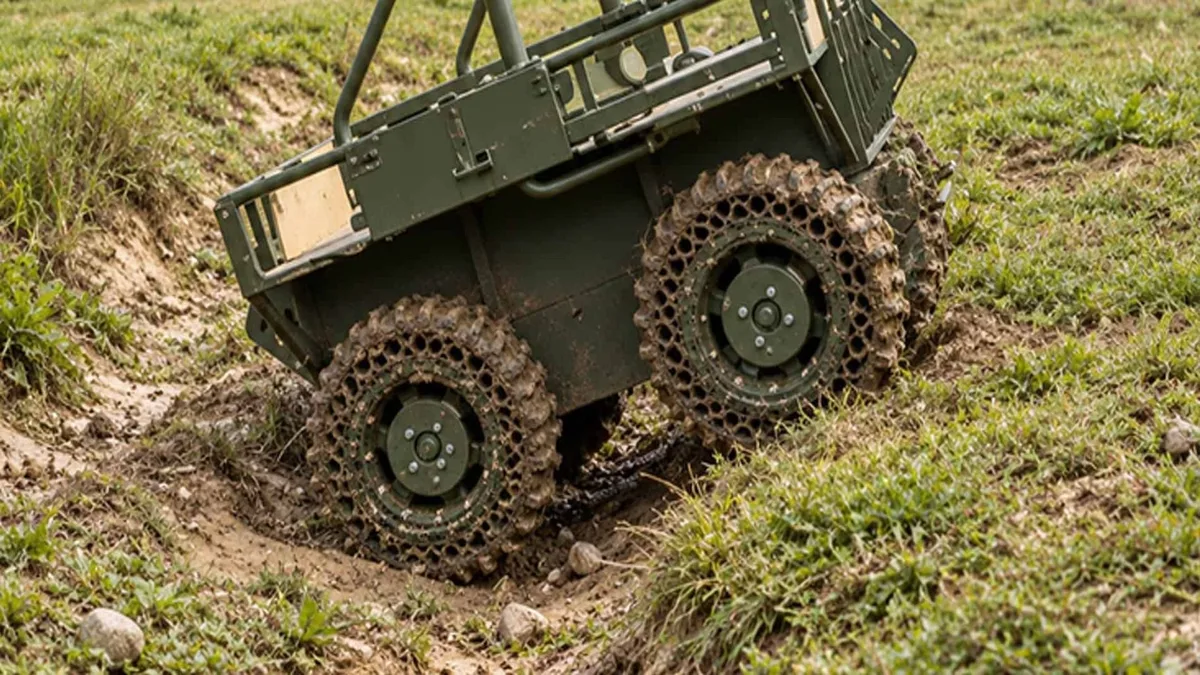
Ukrainian developers complete combat trials of airless wheels for ground robots New 3D-printed wheels eliminate inflation requirements for battlefield robotic vehicles Ukrainian wheel sets weigh between 32 and 56 kg Ukrainian engineers have developed inflation-free wheels for unmanned ground vehicles, aiming to keep robotic platforms moving despite damage encountered during frontline operations.
The project brings together Print&Live UA, iSCALE 3D, and participating specialists, who have completed field evaluations and combat trials of the new wheel designs.
The airless wheel is produced using large-scale 3D printing technology, and it has a rounded tread, a closed profile, and a two-piece disc.
Lightweight construction addresses battlefield mobility risks Its design increases the cross-country ability, energy efficiency, and maintainability of robotic equipment on the front line.
Conventional tyres can become unusable after encountering fragments, blast effects, rubble, barbed wire, or frozen terrain, immobilizing remotely operated vehicles.
Such failures can leave equipment exposed, while recovery operations may require personnel to approach locations where hostile fire remains a concern.
The Ukrainian design eliminates dependence on internal air pressure, allowing the wheel to retain its supporting function without inflation or routine pressure maintenance.
Its internal structure uses a digitally adaptable lattice made from durable elastomers and composite polymers.
Unlike designs with exposed cellular structures or flat running surfaces, the wheels feature enclosed construction and curved tread geometry.
The tyre is designed to limit the amount of dirt, stones and ice accumulating around the wheels during operation over difficult ground.
Their relatively low mass and rounded profile are also intended to limit ground contact and rolling resistance, potentially reducing the energy required for movement.
Print&Live estimates that the design could extend the operating distance of ground robotic vehicles by as much as 30% compared with foreign alternatives.
The complete wheel set weighs between 32 and 56 kg, compared with 88 to 144 kg for the cited foreign airless alternatives.
However, conventional pneumatic sets weigh about 30 to 72 kg, meaning the Ukrainian design does not necessarily outperform every traditional tyre on weight alone.
5News aggregated this summary from the outlet’s public feed. The full article, with all the context, is on www.techradar.com — the content belongs to TechRadar.