Why does the New York Times keep calling the left ‘divisive’?
The newspaper often uses the word to describe elections with progressive contenders, implying a previous whole destroyed by the left
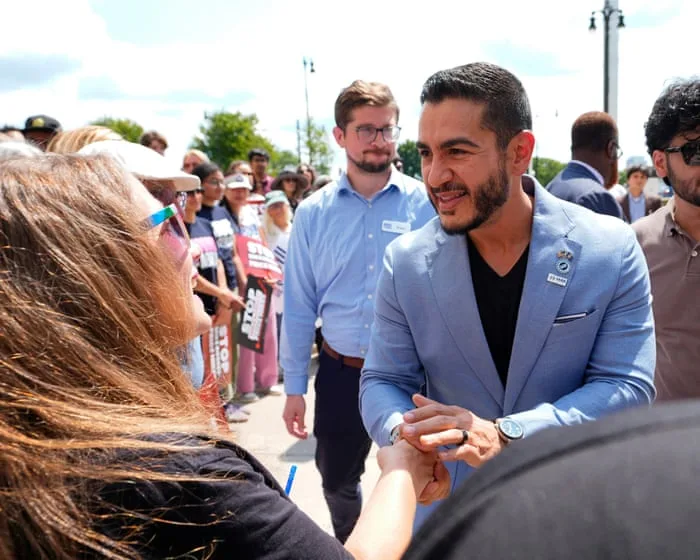
“E l-Sayed and Stevens Project Party Unity After Divisive Race,” announced the New York Times on 5 August, the day the democratic socialist Abdul El-Sayed beat out his centrist Democratic rival, Haley Stevens, in the Michigan senatorial primary. “Divisive” is now the Times’s favorite attack word, deployed repeatedly to disparage and try to undermine the astonishing recent advances by self-identified democratic socialists and other progressive candidates.
Four days after that first story, the Times again landed “divisive” under “Obama and El-Sayed Discuss Unity After Ugly Michigan Primary.” El-Sayed, it asserted, had “narrowly prevailed in a divisive primary after campaigning on a progressive and anti-establishment platform”.
On 12 August, the Times reported that David Crowley, who narrowly beat out Democratic socialist Francesca Hong in the Wisconsin gubernatorial primary, “promised to leave behind the divisive Democratic primary and focus on Mr. Tiffany”, his Republican opponent. Other stories slip it in more subtly. That same day, in a piece about representative Alexandria Ocasio-Cortez allegedly distancing herself from “Woke 1.0”, the Times cited Middlebury College professor Erik Bleich, who “pointed to the calls to defund the police as a divisive goal”.
“Polarizing”, a close cousin to “divisive”, appears regularly, too. The Times especially likes to apply it to New York mayor Zohran Mamdani. A reporter insisted in October 2025, for example: “As Mamdani’s campaign upends New York politics, no single stance has polarized New Yorkers as passionately as his pro-Palestinian activism and caustic criticism of Israel.”
Perhaps most outrageous was the Times’s choice of headline for a recent review of David Zirin’s new book about Howard Zinn: “America’s Most Divisive Historian Gets a New Biography.” How, exactly, was Zinn “divisive”? And who are those other historians who are also divisive, just not at bad? Neither Adam Hochschild, in his review, nor Zirin, in his biography, nor any discussion of I’ve ever seen in 40 years as a practicing US historian (and co-author, along with Robin DG Kelley, of a book with Zinn), talk about Zinn that way.
The Times’s choice to cast Zinn as divisive out of the blue, on top of its repeated usage of the word since the midwest primaries, suggests there’s a conscious campaign underway to utilize the concept however it can.
Overall, the Times’ repeated charge of “divisive”, along with “polarizing”, implies a previous and virtuous whole that is currently being destroyed by the left. It assumes voters agree that in the face of deep fear of Trump and his allies, we have to stick together, and that progressive candidates can’t beat Republicans in the midterms.
But the Times’s mythical unified country never existed. The United States has always been riven by race, class, gender, religion, immigration status and much more.
5News aggregated this summary from the outlet’s public feed. The full article, with all the context, is on www.theguardian.com — the content belongs to The Guardian UK.