Fujitsu ready to sell its custom ‘Monaka’ Arm chip, maybe to rival server-makers
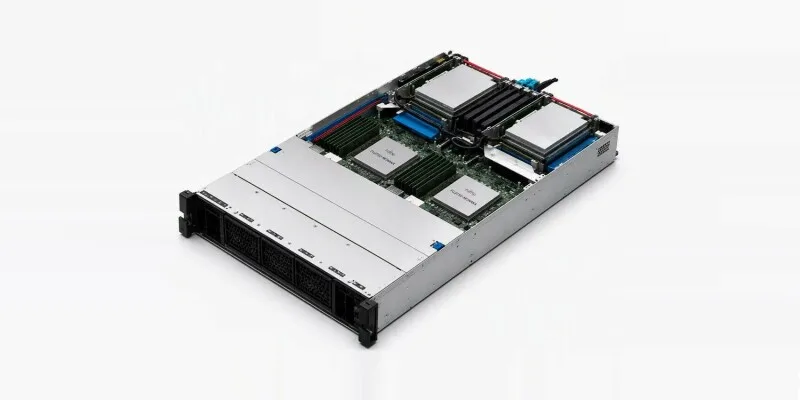
Fujitsu will start selling its Monaka processors, and servers packing them, in November.
The Japanese giant started talking about Monaka way back in 2023, when it teased the processor as being derived from the silicon it designed for the Fugaku supercomputer, but adapted for datacenter use.
Fugaku was the world’s most powerful supercomputer from 2020 to 2022, and remains in ninth place on the Top 500 list six years after its debut.
Who wouldn’t want the tech that powered that behemoth in their datacenter? Yet as The Register reported earlier this year, Monaka diverged significantly from the silicon inside Fugaku.
It’s built on Broadcom’s 3D-chip stacking tech and use the Armv9 ISA.
The chip features a quartet of 2nm compute dies, each packing 36 cores.
Also inside the chip are four SRAM 5nm chiplets, and it’s all connected by a central I/O and memory die with 12 channels of DDR5 and PCIe 6.0 connectivity.
For years, Fujitsu told the Monaka-curious that the chip would see the light of day in 2027.
Earlier this week Fujitsu announced it will start selling the chips, and servers that use it, from November.
The company will sell the chip to cloud operators and server manufacturers.
The latter will have to compete with Fujitsu itself, which has created three servers that use the CPU: A 1U server that can pack one or two processors, running at either 2.1GHz or 2.9GHz, room for eight E3.S SSDs and two M.2 SSDs, and the ability to run in both air-cooled environments where the temperature hits 40C and cope with 45C when using liquid cooling.
A 2U server with a pair of CPUs running at 2.1GHz, four E3.S disks and two M.2s, and supporting only air cooling.
A 2U, dual-CPU model designed to be used for multi-node deployments, four to a rack, running at 2.9GHz, packing just two E1.S SSDs and the two M.2s, and requiring liquid cooling.
This is the model Fujitsu thinks will suit HPC and academic users.
5News aggregated this summary from the outlet’s public feed. The full article, with all the context, is on www.theregister.com — the content belongs to The Register.