Chance gaze at old Hubble Telescope image leads to discovery that could reveal dark matter's secrets
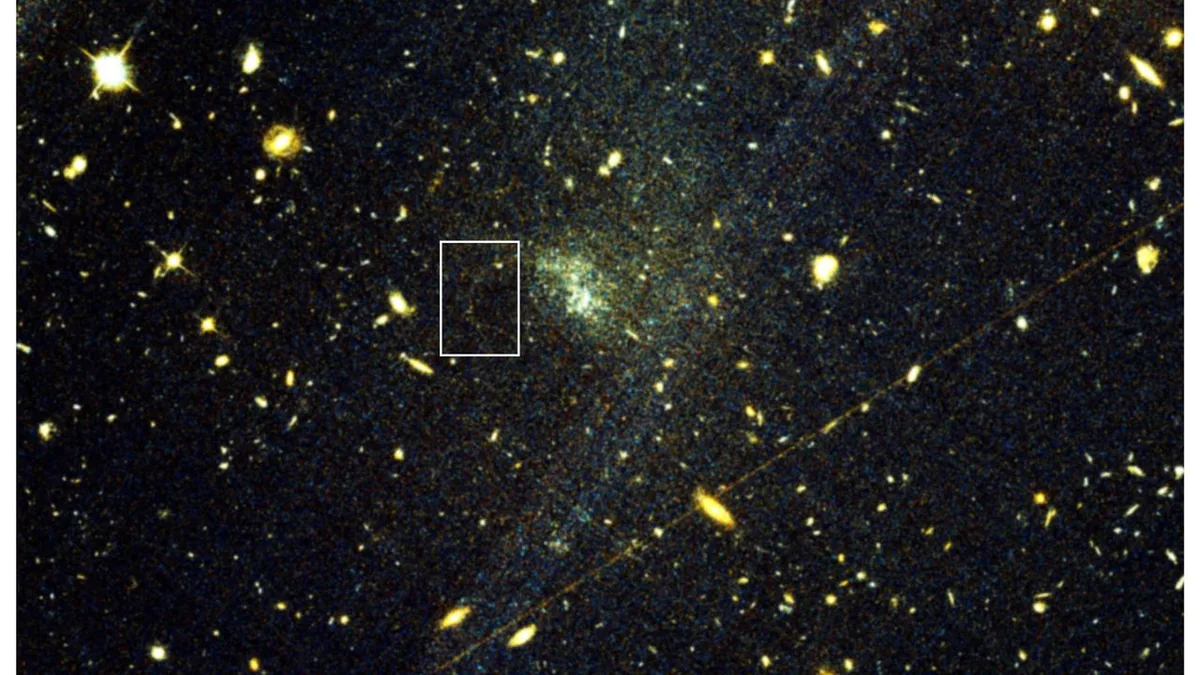
In late June 2023, on a morning train commuting to work in New York City, David Hendel was scrolling through a recent astronomy paper on his phone when a half-page image caught his eye.
The image, captured a year earlier by the Hubble Space Telescope , showed UGC 9050-Dw1, a dwarf galaxy some 115 million light-years from Earth .
It appeared as little more than a faint, diffuse smudge of bluish-white light that astronomers call an ultra-diffuse galaxy — a type of galaxy so sparsely populated with stars that most of its mass is thought to be dark matter , the invisible substance that makes up more than 80% of the matter in the universe but has yet to be directly detected.
What made Hendel pause was not the galaxy itself but a thin, fragile ribbon of stars trailing off from it, so dim it nearly disappeared among the other smudges of light crowding the frame.
Hendel, a former astronomer who had studied thousands of similar structures, immediately recognized the subtle interplay of the arc's features, including the shared color of the stars and their curved trajectory pointing toward a tiny, matching bright knot along its track.
Together, those clues matched a stellar stream tearing from a tight ball of stars called a globular cluster, pulled apart by the gravity of UGC 9050-Dw1.
If Hendel's reading was correct, it would be the first such stream ever found outside the Milky Way .
"It almost seemed too good to be true," Hendel told Space.com.
"At this point I felt the excitement of a discovery to such a degree that I recall looking up and around the train for someone to tell!" This discovery would give researchers a pristine new laboratory for probing dark matter, and one far less contaminated by competing astrophysical forces that muddy similar searches within our own galaxy .
Hendel, who now works in finance but still follows research from his former field, ran a quick literature search to see whether anyone had already documented the feature.
No one had.
The right person to tell was not on the train, of course.
Before reaching his stop, Hendel took a screenshot, sketched a rough circle around the arc and sent it to Sarah Pearson, an associate professor of astrophysics at Technical University of Denmark's DTU Space, and his friend since their graduate school days at Columbia University.
That message kicked off the collaborative effort that would ultimately confirm the find, led by Pearson and Julie Kiel Holm, a Ph.D. student at the Niels Bohr Institute at Denmark's University of Copenhagen.
5News aggregated this summary from the outlet’s public feed. The full article, with all the context, is on www.space.com — the content belongs to Space.com.