Astronomers want your help finding 'missing' black holes in the Milky Way
Astronomers estimate that our home galaxy, the Milky Way, has churned out more than 10 million black holes over its 13-billion-year history.
Yet so far, they have found only 70.
Now, a group of astronomers in the U.K. is trying to close that vast gap by enlisting the public.
Their project, called Black Hole Hunters , is looking for volunteers with a computer and a few spare minutes to sift through troves of data gathered by a NASA space telescope.
By flagging recognizable patterns that could point to a "missing" black hole , volunteers can help fast-track a search that would otherwise take years, the team says.
"You'll be narrowing down precisely where we need to point our telescopes next," project co-lead Adam McMaster, an astronomer at the University of Southampton in the U.K., said in a statement , "and you might be the one to discover a black hole." Cosmic magnifying glasses Black holes form when massive stars roughly 20 times heavier than our sun run out of fuel and collapse, leaving behind an abyss with gravity so immense that even light cannot escape.
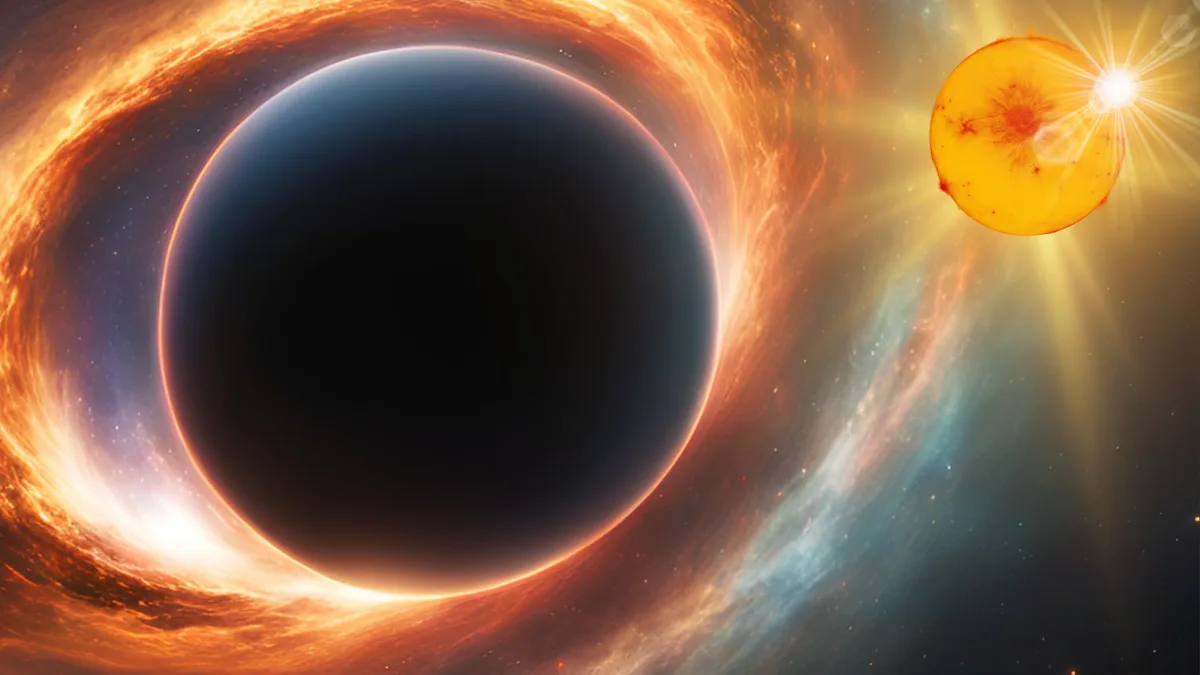
While invisible themselves, these cosmic behemoths reveal their presence by bending the light of nearby objects, and the Black Hole Hunters project is searching for one specific manifestation of this effect.
It happens thanks to the fact that massive stars often form in pairs , and a star can sometimes survive the violent supernova explosion that turns its companion into a black hole.
When that happens, the two bodies continue to orbit each other.
If such a duo aligns just right with Earth, the black hole will periodically pass directly between its companion star and our planet.
And when it does, the black hole's gravity acts like a cosmic magnifying glass , bending and magnifying the star's light, causing it to briefly appear brighter to watchful telescopes.
To find these hidden giants, the project relies on data from NASA's Transiting Exoplanet Survey Satellite, or TESS .
Although the satellite's primary mission is to hunt for planets beyond our solar system , its method of data collection — tracking tiny, continuous changes in a star's brightness over time — is ideally suited for identifying black hole magnification events, the project description notes.
"It's a simple task with no expertise required," McMaster said in the statement.
5News aggregated this summary from the outlet’s public feed. The full article, with all the context, is on www.space.com — the content belongs to Space.com.