'They basically used these dried-up wells just to throw people in': 43 skeletons found in Roman-era well may be evidence of deadly plague
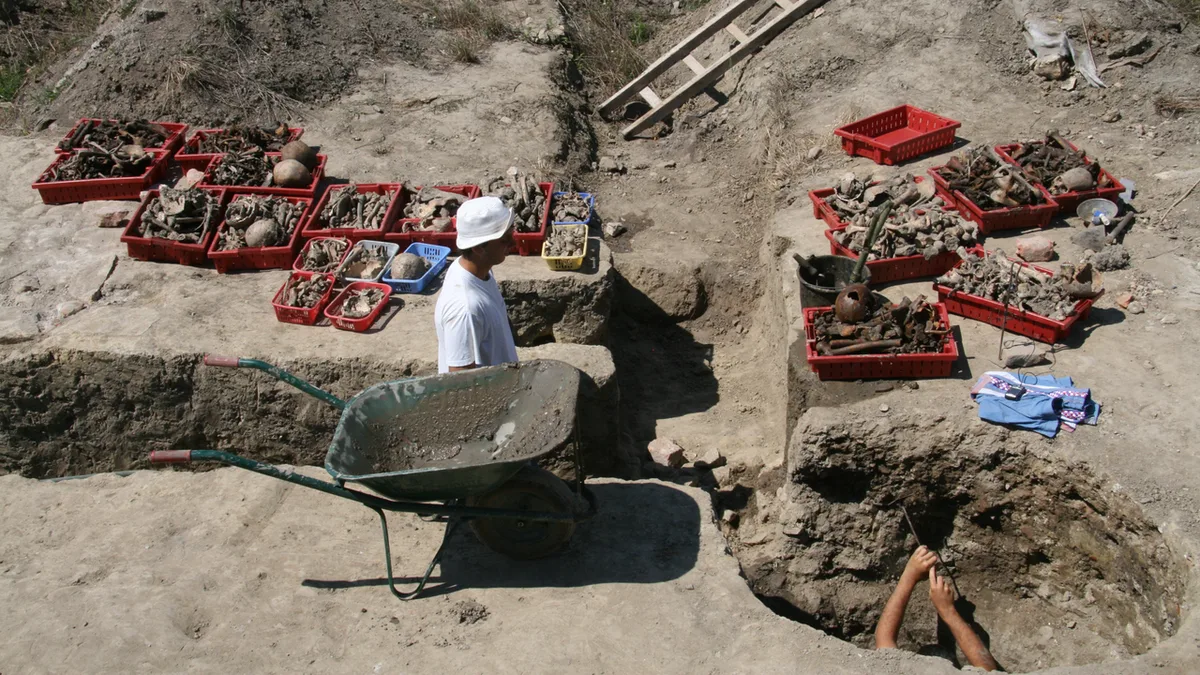
BERLIN — Nearly four dozen skeletons recovered from a deep well in the Croatian city of Osijek may be the remains of people who perished during the historic Plague of Cyprian that ravaged the Roman Empire in the mid-third century A.D.
"We have a whole bunch of these used Roman-period wells that were dug in antiquity," Mario Novak , a bioarchaeologist at the Institute for Archaeological Research in Zagreb, told Live Science.
"They basically used these dried-up wells just to throw people in — either from battle or from epidemics." Novak presented new research on the enigmatic burial Aug.
6 at the 25th European Paleopathology Association meeting in Berlin.
It has not yet been published in a peer-reviewed journal.
The burial was excavated in 2008 near a Roman necropolis in Osijek, which was founded by Emperor Hadrian in A.D.
133.
At the time, the city was part of the province of Pannonia and named Mursa .
The city of Mursa was important in Roman times because soldiers stationed there helped protect the Danube and the limits of the Roman Empire, but much of the ancient city still lies unexcavated beneath modern Osijek.
Novak and his team previously found two wells full of young male skeletons that had suffered violent injuries around the time of their deaths.
This led the researchers to conclude that the men may have been involved in the Battle of Mursa in 260.
But the newly analyzed skeletons were very different from the previous mass burials, Novak said in his presentation.
At least 43 people were buried in the well, and the dead included adults and children of both sexes.
None of them had any major injuries.
5News aggregated this summary from the outlet’s public feed. The full article, with all the context, is on www.livescience.com — the content belongs to Live Science.