Glowing galaxy with anomalous extra arms | Space photo of the day for Aug. 27, 2026
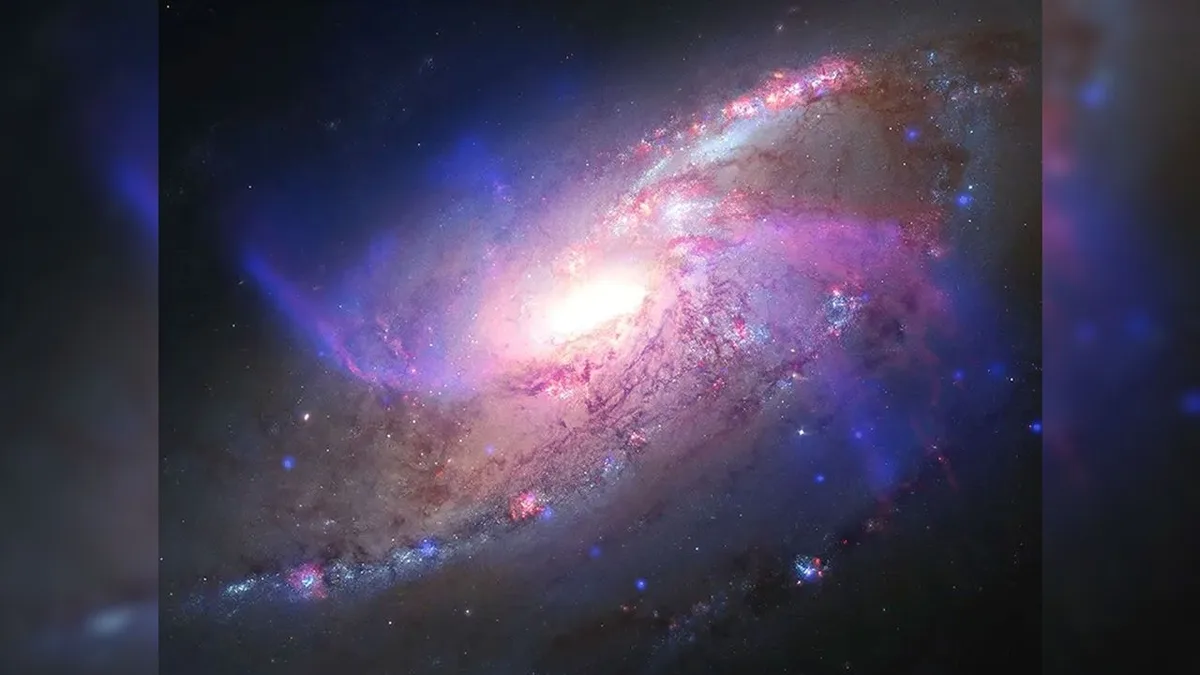
An image of this spiral galaxy NGC 4258 that combines X-ray observations from NASA's Chandra X-ray observatory (seen here in royal blue), optical light gathered by the Hubble Space Telescope (red, yellow and pale blue), and infrared light seen by the James Webb Space Telescope (bright orange). (Image credit: X-ray: NASA/CXC/SAO; Optical: NASA/ESA/STScI; Infrared: NASA/ESA/CSA/STScI; Image Processing: NASA/CXC/SAO/L.
Frattare) A trio of NASA space telescopes teamed up to capture a gorgeous new look at the glowing spiral galaxy NGC 4258 and its two anomalous extra arms.
What is it? This image shows NGC 4258 , also known as Messier 106, a spiral galaxy located some 24 million light-years away in the constellation Canes Venatici , the "Hunting Dogs." It is a fairly bright galaxy and can be viewed in the spring sky in the Northern Hemisphere with most telescopes.
Messier 106 is noteworthy for having two "anomalous" extra arms, the long curved regions of bright gases, dust and young stars that are characteristic of all spiral galaxies.
But while most spiral galaxies have only a pair of arms, Messier 106 has two pairs.
According to NASA , the extra set is composed of hot gases that are churned away from the galactic center by the supermassive black hole at the heart of NGC 4258.
Why is it incredible? This image shows off the incredible teamwork that NASA's flagship orbital observatories can pull off.
It combines X-ray observations from NASA's Chandra X-ray observatory (seen here in royal blue), optical light gathered by the Hubble Space Telescope (red, yellow and pale blue), and infrared light seen by the James Webb Space Telescope (bright orange).
By combining multiple types of light into one image, NASA is able to reveal the complete picture of what this energetic galaxy is made of.
The image also shows the incredible power of the black holes found at the centers of galaxies.
"M106 helps show how supermassive black holes can create structural features that mimic star-bearing spiral arms, influencing a galaxy's evolution," NASA wrote in a statement accompanying the image.
This image was part of a NASA release of 16 new " galactic gems " captured by Chandra and other observatories.
5News aggregated this summary from the outlet’s public feed. The full article, with all the context, is on www.space.com — the content belongs to Space.com.