On this day in space! Aug. 26, 1978: Sigmund Jähn becomes 1st German in space
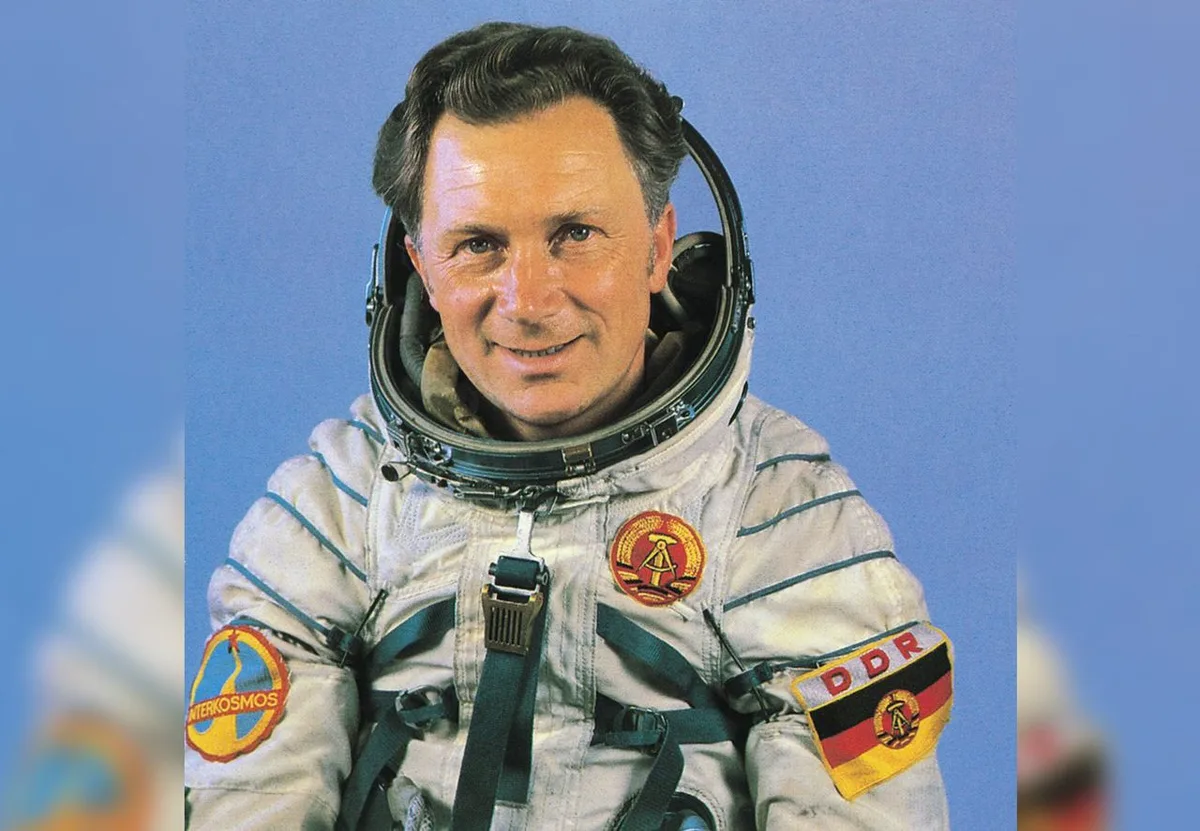
On Aug.
26, 1978, cosmonaut and pilot Sigmund Jähn became the first German to fly in space.
Jähn was an experienced pilot for the East German Air Force and studied at the Gagarin Air Force Academy in the Soviet Union in the 1960s .
In 1976, he and one other German pilot were selected for the Interkosmos program, which was designed to help the Soviet Union's allies with space missions.
Jähn joined three Soviet cosmonauts on the Soyuz 31 mission to the Salyut 6 space station, where he took photos of the Earth using a new multispectral camera.
He also conducted experiments in biology, physics and materials science.
After almost 8 days in space, he safely returned to Earth .
Why it mattered Sigmund Jähn, the first German cosmonaut to fly into space in his Soyuz spacesuit in 1978. (Image credit: ESA) Jähn's flight to the Soviet Union's Salyut 6 station is one of the earliest examples of partner nations flying with an ally on a collaborative space mission.
He flew just three years after the first-ever international space mission, the Apollo-Soyuz Test Project flight between NASA and the Soviet Union.
Today, such missions are commonplace at the International Space Station , which has seen astronauts from many countries visit as part of missions by the five space agencies overseeing it ( NASA , Russia's Roscosmos , the European Space Agency , Japanese Aerospace Exploration Agency and Canadian Space Agency ).
Soyuz 31 crewmates Valery Bykovsky and Sigmund Jähn are seen after landing in Kazakhstan in September 1978. (Image credit: DLR/Roscosmos) Jähn conducted 25 different experiments on his Soyuz 31 flight with cosmonaut Valeri Bykovsky.
Those experiments covered a range of topics, including geophysics, materials science, medicine, biology, and remote sensing, ESA has said .
After his spaceflight, Jähn led East Germany's new Space Training Centre at Eggersdorf near Strausberg until 1990, when the East German Air Force was dissolved.
He was discharged with the rank of major general.
5News aggregated this summary from the outlet’s public feed. The full article, with all the context, is on www.space.com — the content belongs to Space.com.