Supermassive black hole blasts out a neon 'treble clef' | Space photo of the day for Oct. 16, 2026
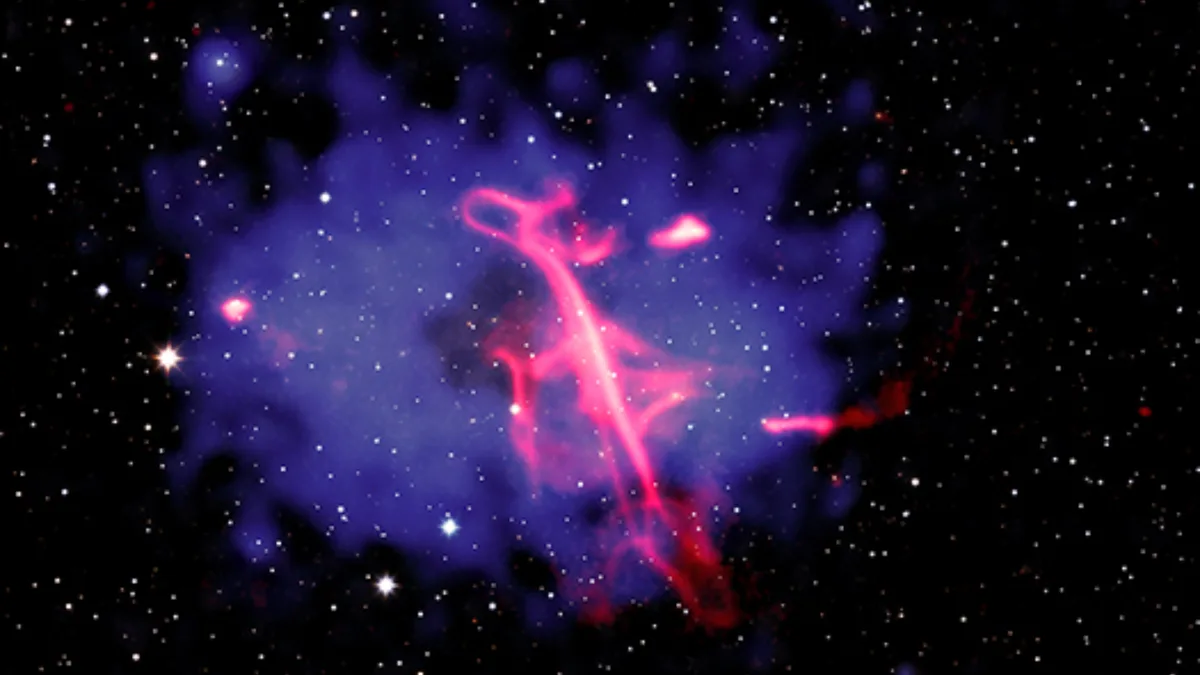
The "treble clef" galaxy cluster is an unusual source of radio waves, the Chandra X-ray observatory has found. (Image credit: X-ray: NASA/CXC/INAF-IRA/A.
Botteon et al.; Infrared: UKIDSS-GPS ; Radio: ASTRON/LOFAR; Image processing: NASA/CXC/SAO/N.
Wolk) What looks like a neon pink treble clef floating out in space is actually a bizarre source of radio waves spotted deep in the cosmos.
What is it? Scientists using NASA's Chandra X-ray Observatory have peered far out into space to look at strange radio waves coming from what they have nicknamed the "treble clef" because of its distinct shape, which looks a lot like the musical notation.
Using Chandra, as well as the German Extended RÖntgen Survey with an Imaging Telescope Array ( eROSITA ) X-ray telescope, researchers looking at this strange sight spotted a big cloud of blue gas, which we can see in this image, along with radio signals (seen here in bright pink).
They think that this object is actually a huge galaxy cluster made up of two different clusters that are in the process of merging.
Why is it incredible? The researchers think they may have gotten to the bottom of where these radio waves are coming from, they report in a new study.
The team thinks that the treble clef-shaped radio signals were created by an outburst from a supermassive black hole .
They believe that this outburst pushed clouds of charged particles and magnetic fields away from the galaxy cluster's center, producing bright radio waves.
According to the scientists, following this bright outburst, there was likely an extreme collision between two galaxy clusters.
This cosmic smash-up either compressed or somehow reenergized these charged particles to amplify the radio signal.
When we see beautiful images of objects in space such as this, they can seem just like peaceful, colorful, cosmic clouds.
But when you look a bit deeper, these spectacular scenes can actually be evidence of violent, chaotic events.
This work was described in a study published in the journal Astronomy & Astrophysics.
5News aggregated this summary from the outlet’s public feed. The full article, with all the context, is on www.space.com — the content belongs to Space.com.