Goldman says the economy is rewarding capital ownership over labor — and most Americans don’t own enough of it to benefit
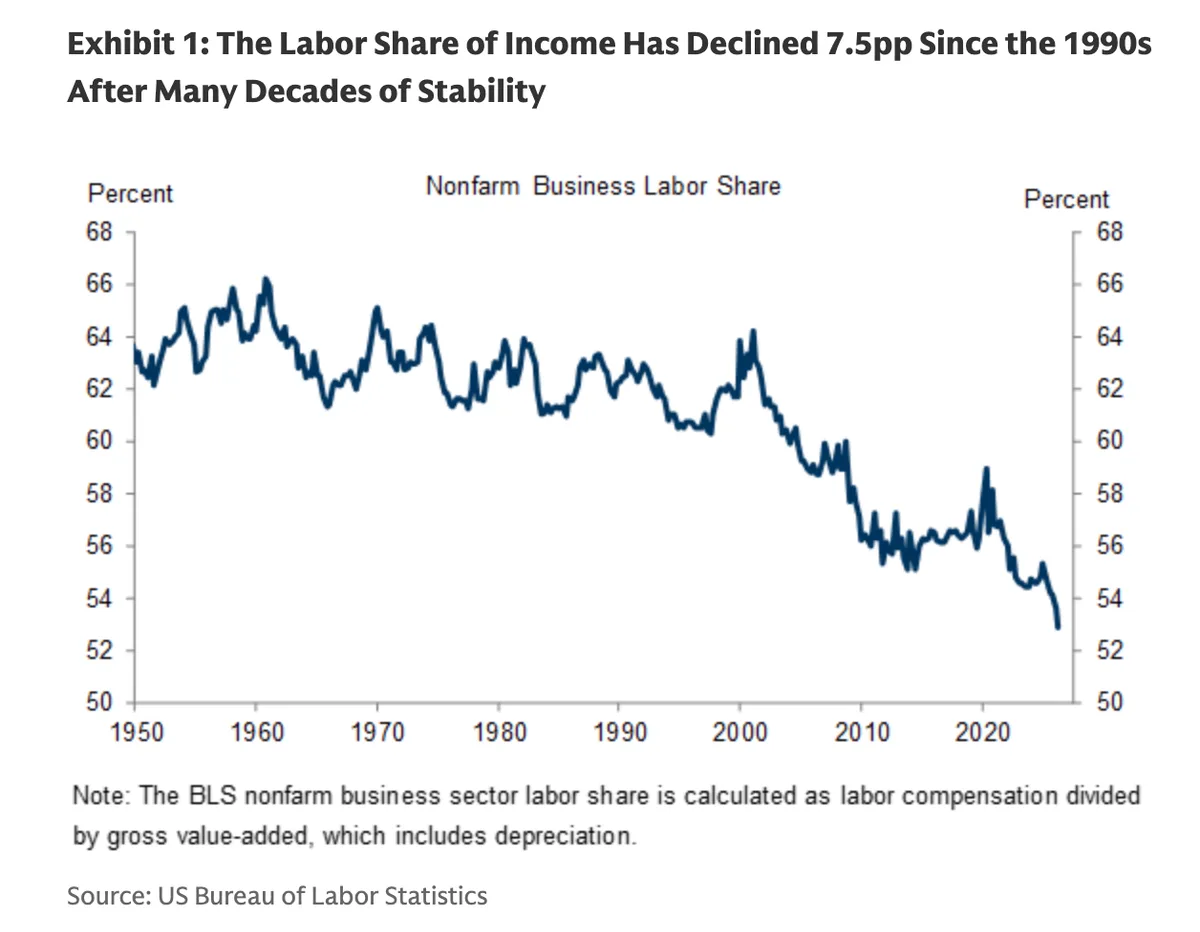
Workers have been taking home a shrinking slice of the American economy for more than three decades, and the headline number is stark: the labor share of income in the nonfarm business sector has fallen roughly 7.5 percentage points since the 1990s, according to Bureau of Labor Statistics data cited in a September 15 Goldman Sachs research note.
That decline has accelerated into record territory this year — BLS data released in early September put labor’s share of nonfarm business output at just 52.8% to 52.9% in the second quarter of 2026, the lowest reading since the agency began tracking the measure in 1947.
But according to Goldman economist Abhay Duggirala, much of that decline is not what it appears to be.
In a report titled “What Explains the Decline in the Labor Share of Income?,” Duggirala estimates that roughly 40% of the 7.5-point drop reflects measurement quirks in how the government counts wages and profits — not an actual transfer of income from workers to capital owners.
The remaining 60%, or about 4.5 percentage points, is real, Goldman concludes, and it traces mostly to rising corporate markups, automation and the decades-long erosion of workers’ bargaining power.
Goldman’s report is also another key piece of evidence in answering a question gripping the 2020s: is the American middle class actually shrinking? The answer, this new data suggests, is yes — but not for the reason most people assume.
A wave of cutting-edge economic research — from federal data on income shares to original surveys on how Americans actually spend and feel about their money — is complicating the simple “shrinking middle class” narrative and replacing it with something more unsettling: a picture of an America that has grown genuinely wealthier by nearly every historical measure, yet is struggling to feel it, recognize it, or convert it into the kind of security and status that used to come standard with a paycheck.
The 40% isn’t what it looks like Goldman’s case for discounting nearly half the decline rests on three accounting distortions, each tied to a real economic shift but not to money actually moving from paychecks to profits.
The first is a tax-driven relabeling of income.
Research by economist Matthew Smith and coauthors found that the 1986 Tax Reform Act, which raised the relative tax burden on C-corporations, pushed a wave of business owners into pass-through structures like S-corporations and partnerships.
Income that once showed up as wages now gets reported as business profits instead — the same dollars, filed under a different label.
5News aggregated this summary from the outlet’s public feed. The full article, with all the context, is on fortune.com — the content belongs to Fortune.