Tehran Has to Make a Choice
Sign up for our newsletter about national security here .
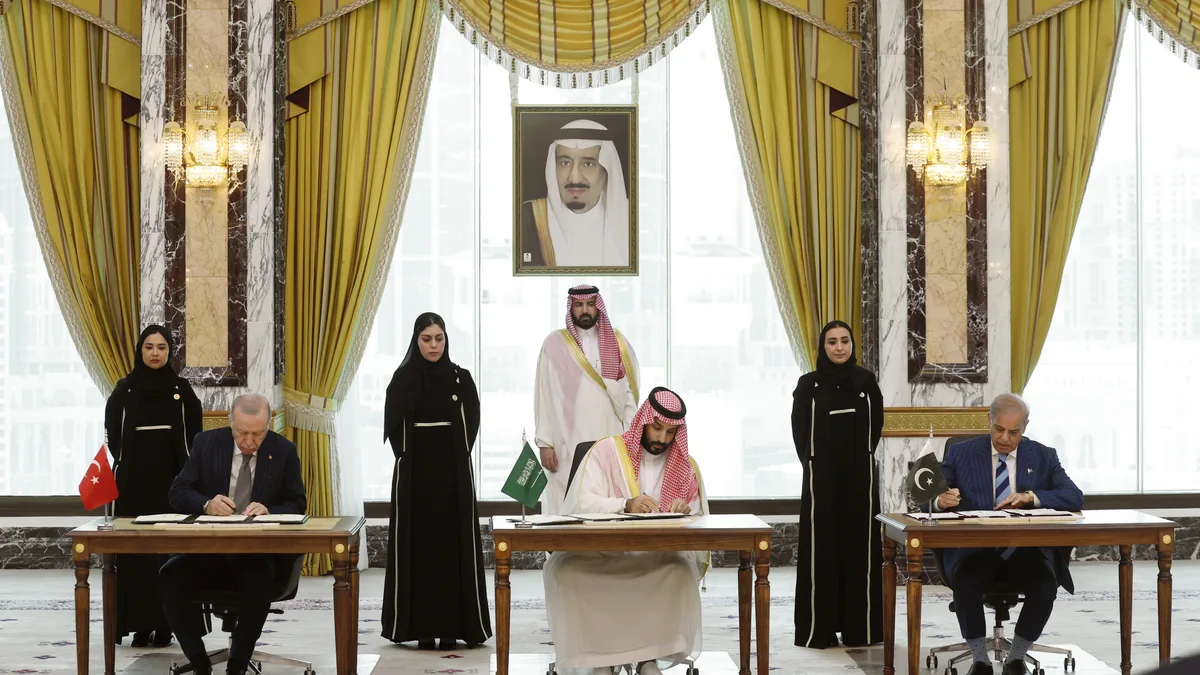
When the leaders of Saudi Arabia, Pakistan, and Turkey got together last week to forge a new defense agreement, they emphasized that their pact wasn’t aimed at any particular country.
But one country was surely on everybody’s mind: the Islamic Republic of Iran.
Iran has positioned itself as the most overtly anti-Western state in the region, and the coming together of three prominent Muslim-majority countries aligned with the West, two of which have land borders with Iran, signals its isolation.
Iran has endured months of war with Israel and the United States without losing, but it has done so in part by repeatedly attacking neighboring countries that house U.S. military bases.
Now these countries are among those closing ranks against Iran in an agreement signed in and named for Mecca, Islam’s holiest city.
The symbolism can’t be lost on Tehran.
The parties to the Mecca pact include some of the world’s most powerful Muslim-majority countries: the two with the biggest economies in the region (Turkey and Saudi Arabia, which also spend the most on their militaries), and the Muslim world’s sole nuclear power (Pakistan).
Iran has traditionally maintained good relations with Turkey and Pakistan; its cultural bonds with these two countries are strong and go back centuries.
More recently, the Islamic Republic has worked to improve its relations with Saudi Arabia, particularly since reestablishing diplomatic ties with Riyadh in 2023. [ Read: Iran goes looking for love in Jordan ] Even so, Iran’s regional policies have put the country at odds with these and other neighbors.
Tehran gave its full support to the regime of Bashar al-Assad in Syria, which rebels who were backed by Ankara and Riyadh overthrew in 2024.
The Iranian military exchanged strikes with Pakistan in 2024 and attacked Saudi Arabia in recent weeks.
Iranian missiles were intercepted over Turkish airspace earlier this year.
Tehran-backed militias in Yemen and Iraq have attacked Saudi interests.
5News aggregated this summary from the outlet’s public feed. The full article, with all the context, is on www.theatlantic.com — the content belongs to The Atlantic.