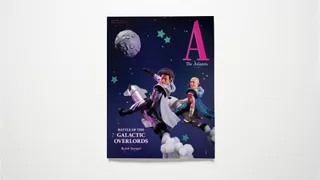
The Incredible Ambitions, and Rivalry, of Musk and Bezos

Subscribe here: Apple Podcasts | Spotify | YouTube | Overcast | Pocket Casts Back in March 2025, the Department of Government Efficiency, led by Elon Musk, dropped news in the dead of night.
“Good work by @NASA this week,” the post said.
“Eliminated their unused purchasing Cards (~80%) -Terminated ~$420M in unneeded contracts, including $45M ($15m each) to three separate consultants.” The irony should not require explanation, but as my colleague Josh Tyrangiel details in his new cover story, Musk’s company, SpaceX, might not exist today without the $1.6 billion contract it received from NASA back in 2008, when it was days away from missing payroll, to resupply the International Space Station.
“The company had gone from near death to indispensable in a single quarter,” Tyrangiel writes.
Musk’s space ambitions are no secret—and they are matched, perhaps, only by the ambitions of Amazon’s founder, Jeff Bezos.
In 2018, a decade after Musk’s company became the first private one to launch a liquid-fueled rocket into space, Bezos said the only way to “deploy this much financial resource is by converting my Amazon winnings into space travel.
That is basically it.” Private individuals have long been a part of America’s relationship with space, but the nation is now reliant on one or two people to ensure that they can achieve the goals they set.
On Radio Atlantic , Josh joins me to talk about how the relationship between NASA and these companies developed, the competition between the two men, and what it means for all of us down here on Earth.
The following is a transcript of the episode: Josh Tyrangiel: Part of what Musk and Bezos are seeing is that right now space is an okay business.
It’s not great.
Satellites: better business.
But down the road, if you can get satellites connected to data centers in space, and you have AI models that are super thirsty for computing power and for energy, all of a sudden you have a very virtuous loop that makes it really hard to compete with you in any part of that vertically integrated business. [ Music ] Adam Harris: This is Radio Atlantic .
I’m Adam Harris, and today we need to talk about the new space race.
Public and private partnerships have defined the nation’s relationship with space for a long time.
5News aggregated this summary from the outlet’s public feed. The full article, with all the context, is on www.theatlantic.com — the content belongs to The Atlantic.