Inside a Philadelphia barbershop, Black men debate their political past and future
PHILADELPHIA (AP) — Ever since Democrat Kamala Harris lost the presidential election to Donald Trump two years ago, political strategist Khalil Thompson has been traveling the country to figure out why Black men inched toward a white Republican rather than a Black woman.
Although Black men vote overwhelmingly Democratic, even small shifts in their support can help swing razor-thin elections. They are often some of the most scrutinized but least understood voters, a blind spot that Thompson wants to fix.
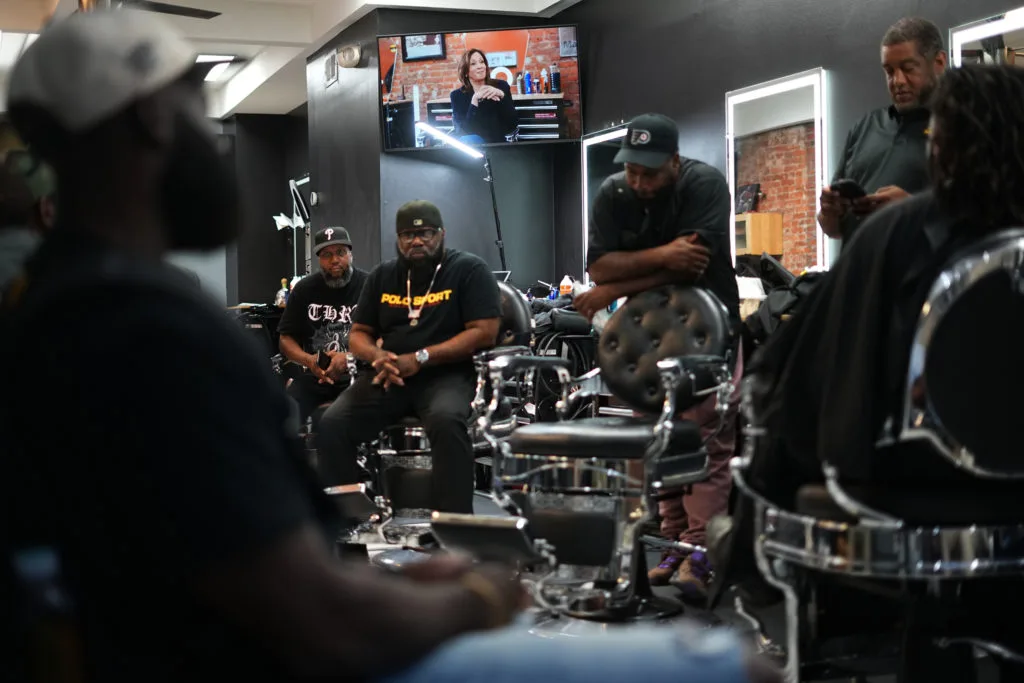
His mission led him to a Philadelphia barbershop one recent Friday night, where Thompson's organization, Win With Black Men, organized a conversation that mixed with the sounds of buzzing clippers and a break to eat cheesesteaks.
"We know the shop is like our own country club that we come to, so we really just want to start having a conversation about what's important to us in our community," Thompson told the few dozen people who were getting their hair cut, sat in chairs lined up around the room or stood wherever they found extra space.
The two-plus hour discussion, which included local politicians, union leaders, lifelong residents, recent arrivals and a few high schoolers, had immense political stakes. While Philadelphia is a liberal stronghold and not at play in this year's midterm elections, it is crucial in presidential elections. If Democrats cannot run up their numbers in the city, where Black residents are 40% of the population, it's much harder for them to win Pennsylvania. Democrats face similar tests across the country.
"I am a middle-class Black man who lives in D.C. I have no idea what the various day-in-the-life needs would be of the brother who goes to the Bill Pickett rodeo in Houston, the brother that may work on a peanut farmer in Albany, Georgia, versus the brother that lives in Oakland or one who lives in Detroit and goes to work at a car factory plant," Thompson later told The Associated Press. "When you're polling, messaging, making TV decisions for Black men with one monolithic filter, you're going to lose a broad swath."
As the conversation got underway, Thompson raised the key question that he has been pondering: Why didn't some Black men enthusiastically support Harris, the first Black woman nominated for president by a major political party?
One exchange reflected the raucous but familiar debates some Black men have had with each other since Trump's return to the White House.
Stanley Thigpen, a civil engineer, had a theory about Black men and Trump, who he described as "Big T over in 1600," a reference to the White House's address at 1600 Pennsylvania Ave.
Thigpen said he is not a supporter, but "what we fail to realize is Trump has always been a prominent figure in Black culture," he said. Groans, laughs and objections immediately followed.
"I gotta push back on that," interjected Al Glay, a real estate agent.
"You can't push back on that!" Thigpen retorted.
5News aggregated this summary from the outlet’s public feed. The full article, with all the context, is on www.pbs.org — the content belongs to PBS NewsHour.