1-billion-year-old Mars meteorite found in Algeria is like nothing we've seen from the Red Planet
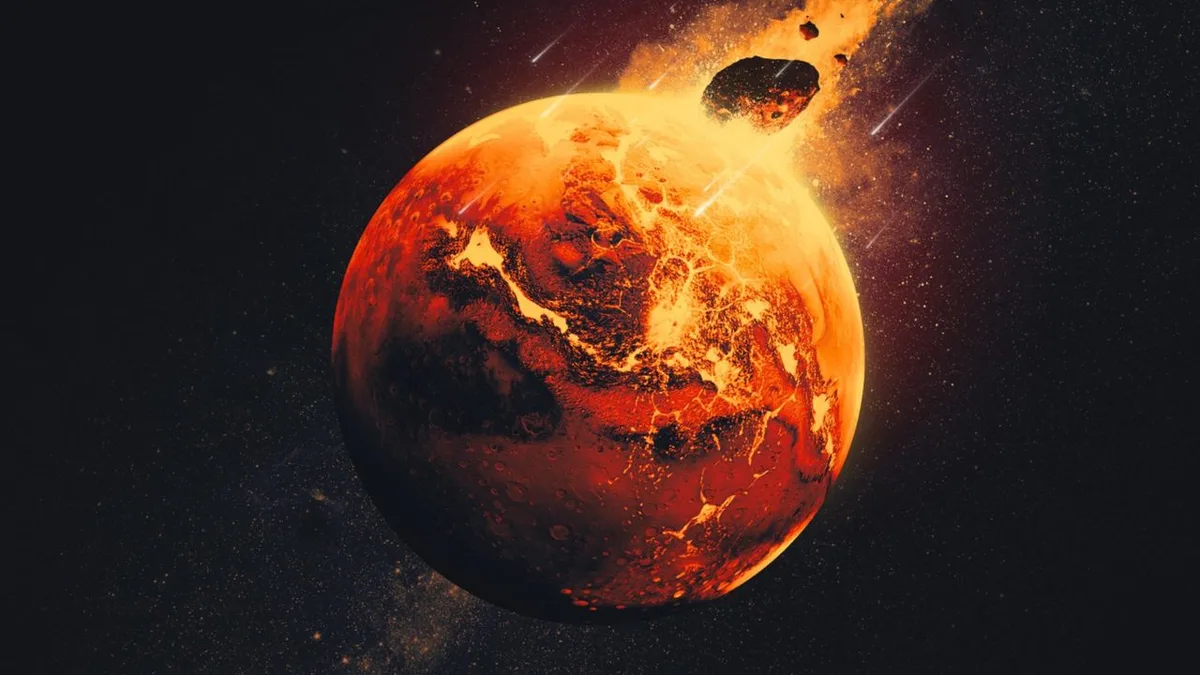
A newly found Mars meteorite is revealing the secrets of a previously hidden time period of Red Planet geological history.
The 1.27-billion-year-old space rock, called Northwest Africa (NWA) 13441, was discovered in Algeria in 2019 — but its age was not confirmed until recently.
Now scientists say the meteorite helps answer questions about a huge gap in the Martian geologic record: a span of time between 600 million years ago and 2.4 billion years ago.
This vast timespan has no known examples of meteorites containing igneous (solid magma) shergottites, which are the most abundant type of Martian meteorites , chunks of the Red Planet that were blasted away by impacts, ejected into space and eventually fell to Earth .
The only meteorites known from this time range, roughly 1.3 billion to 1.4 billion years ago, are rarer types known as chassignites and nahklites.
As such, the newly analyzed meteorite is opening new insights already about this time period.
"The characteristics of this meteorite were entirely surprising," stated Boston College Earth and environmental sciences professor Ethan Baxter, co-author of a study published Aug.
1 in the journal Geochimica et Cosmochimica Acta.
"No other Martian meteorite like this has an age of 1.27 billion years old." NWA 13441 was surprising to researchers in two ways.
The first was its composition — while it is a shergottite, the space rock also contains isotopes (element types) of a rare-Earth metal called neodymium.
Neodymium is usually found in chrondrites — another kind of meteorite made up of unmelted rocks — and chondrites were common in the solar system when it was formed 4.56 billion years ago.
This blended composition of shergottite and chrondrite suggests deeper parts of Mars have remained relatively untouched since the planet was formed, Baxter stated.
That finding aligns with what scientists already know about Mars, which likely formed only five million years after the solar system was formed. ( Mars also has no plate tectonics , making it different from Earth and which allows the earliest bits of it to remain undisturbed by the types of geologic processes that take place on our planet.) A different Mars meteorite found in Northwest Africa, known as 7635.
It is a shergottite believed to be around 2.5 billion years old. (Image credit: Mohammed Hmani) Peering deeper at the chondrites added a second surprise: the composition of the isotopes, or element types, are helping establish "new boundaries on the processes that happened in the very early solar system as Mars formed," the authors stated.
5News aggregated this summary from the outlet’s public feed. The full article, with all the context, is on www.space.com — the content belongs to Space.com.