Behold the majestic mane of the Lion Nebula | Space photo of the day for Aug. 11, 2026
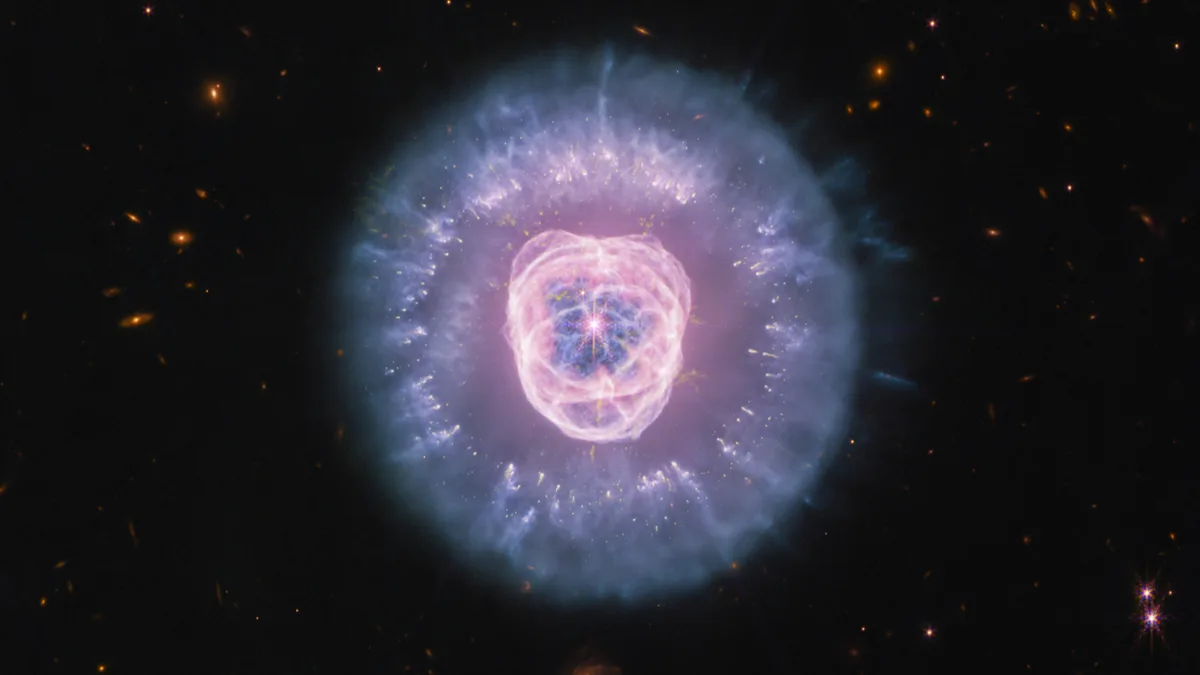
The Lion Nebula glows gloriously in this new snapshot from the James Webb Space Telescope, made using data from the NIRCam and MIRI instruments.
Image: NASA, ESA, CSA, STScI; Image Processing: Alyssa Pagan (STScI) The Lion Nebula glows gloriously in this new snapshot by the James Webb Space Telescope using data from JWST's MIRI instrument.
Image: NASA, ESA, CSA, STScI; Image Processing: Alyssa Pagan (STScI) With a glorious mane of glowing purple gas and dust, the Lion Nebula sparkles on the cosmic savanna in this new image captured by the James Webb Space Telescope .
What is it? This new image highlights the stunning beauty of the Lion Nebula (formally named NGC 2392), which earned its nickname thanks to its vaguely lion-head-shaped "face" and surrounding, fuzzy "mane".
At the center of this lion's face lies its nose, a bright purple spot.
This spot is actually the remnant of a dying star that's radiating energy outward and powering the cosmic structure.
This oxygen-rich remnant is a white dwarf, or the hot core of a dying star.
As a star like this dies, it becomes unstable and sheds its outer layers, blasting gas and dust outward to create a planetary nebula.
The white dwarf got left behind after the nose in the center of the "lion's" face expelled energy and created a big bubble of ionized gas around itself.
Over time, the lion's face will continue to expand.
Astronomers estimate that in about 10,000 years, the lion might dissipate entirely.
Why is it incredible? This isn't the first time we've seen the Lion Nebula.
Back in 2000, for instance, the Hubble Space Telescope took a close look at the nebula.
However, the JWST snapped this image of the nebula using two of its state-of-the-art instruments: the NIRCam (Near Infrared Camera) and MIRI (Mid Infrared Instrument).
5News aggregated this summary from the outlet’s public feed. The full article, with all the context, is on www.space.com — the content belongs to Space.com.