'Like a jail door slamming': Male sperm whales' mysterious rhythmic clanging is the loudest communication sound of any animal
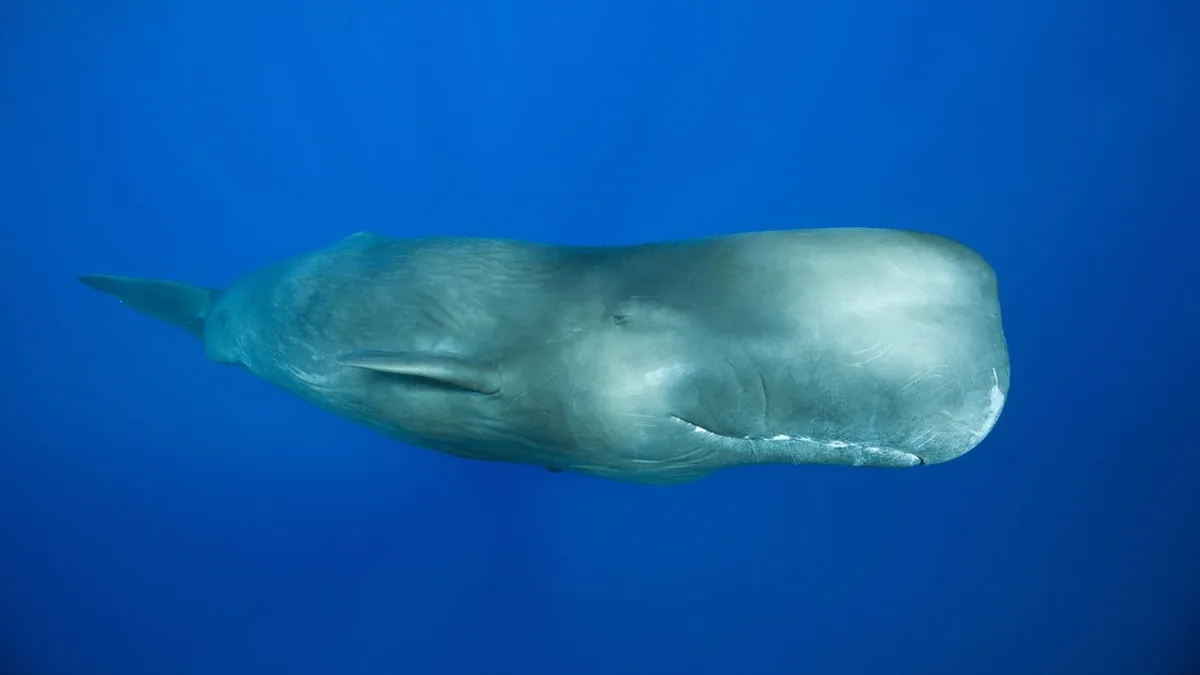
Sperm whales make the loudest communication sound of any animal on Earth, researchers find — but they aren't sure why.
In a new study, researchers investigated the mysterious, low-frequency clangs made by male sperm whales and found that they were louder than any known sperm whale communication signal, with the potential to be heard by other whales around 43 miles (70 kilometers) away.
They are very loud and metallic sounds that almost sound "like a jail door slamming," which is "why they are also called clangs," study first author Simone Videsen and co-author Peter Teglberg Madsen , biologists at the Center for Active Sensing with Sound at Aarhus University in Denmark, told Live Science in an email.
"You feel small as a human when you hear them, as they are clearly made by something bigger than you," they said.
Sperm whales ( Physeter macrocephalus ) are the largest toothed predators, growing up to around 59 feet (18 meters) long.
They dive deep into the ocean to hunt giant squid ( Architeuthis dux ) and other prey that dwell as low as 1.9 miles (3 km) below the ocean surface.
The distinctive clangs, first reported in the 1980s , are the loudest communication signal that sperm whales make, although they can produce even louder echolocation clicks to locate prey during hunts.
The clangs are unusual because they are made only by males and represent an extreme form of communication that scientists still can't fully explain.
In the latest study, the researchers used hydrophones (underwater microphones) off the Seychelles to measure the sound level of the clangs.
They also studied the rhythm of the signals in recordings collected in other locations, including off Sri Lanka, Norway and Scotland.
The recordings revealed that the whales kept up a slow, low-frequency rhythm, unlike the short, rhythmic clicks that both males and females make for typical social communication or the clicks used in echolocation.
In fact, the rhythm was so slow that males left a gap of 5 to 10 seconds between each clang.
That might not sound that impressive — but as far as we know, whales can't count to 10 , so they are using another means to keep up this rhythm.
According to the study, the whales might be relying on the echoes of the clangs bouncing off the seafloor.
5News aggregated this summary from the outlet’s public feed. The full article, with all the context, is on www.livescience.com — the content belongs to Live Science.