The Milky Ways center holds the ruins of another ancient galaxy
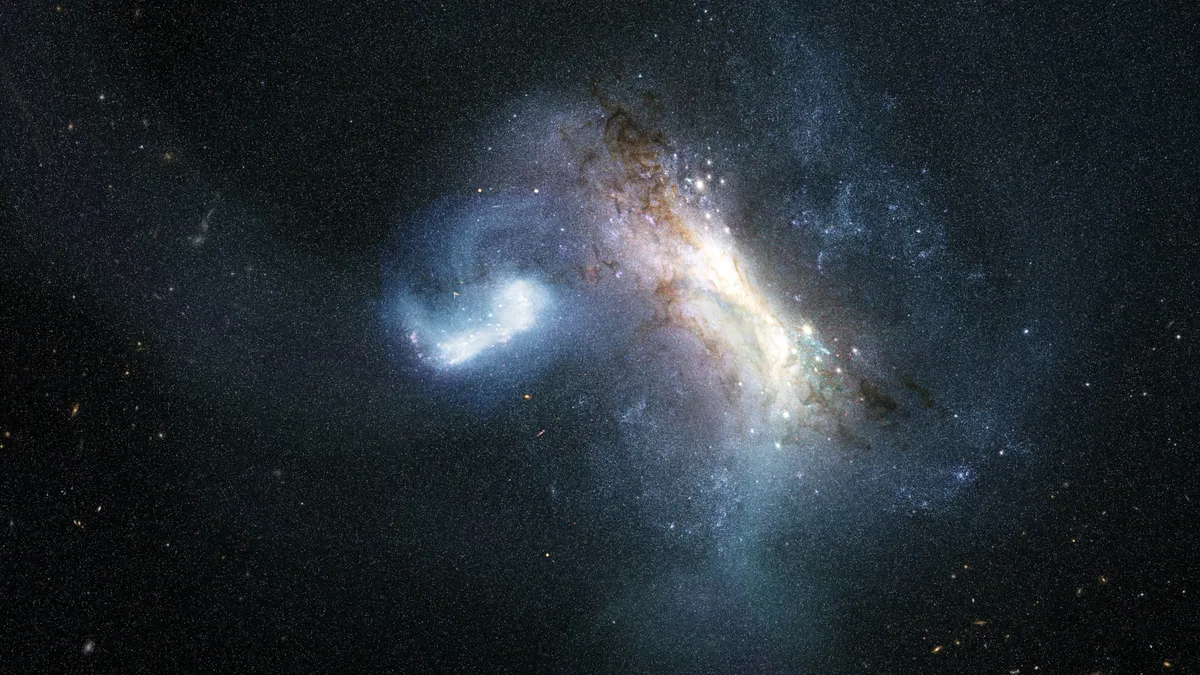
Astronomers have uncovered the 12.3-billion-year-old ruins of an ancient galaxy hiding in the jumbled jungle of the Milky Way's center .
For billions of years, our home galaxy grew into a cosmic giant by crashing into and absorbing smaller neighboring dwarf galaxies.
Over years of research, scientists have mapped several of these galactic mergers , including a slow-speed collision with the Sagittarius dwarf galaxy, which began roughly 6 billion years ago.
Scientists say it continues today.
The discovery of this even earlier space merger, published in Nature Astronomy , helps make sense of the tangled mess that is the center of the galaxy.
And it shows that scientists can use the ages and ingredients of star clusters to retrace the steps of the Milky Way's violent past.
"Our home is the Milky Way galaxy, but we do not know how our house was built," said Davide Massari, lead author of the research, in a statement .
"In this paper, we discover where the first significant batch of bricks came from." SEE ALSO: Bright planets can blind the Webb telescope.
A fix is coming.
Before this new finding , astronomers considered a collision with a massive galaxy named Gaia-Sausage-Enceladus to be the oldest major impact.
That wreck occurred about 10 billion years ago and contributed to the bulge in the Milky Way's massive, thick disk of stars.
Given that billions of years have passed, peering back into earlier phases of galactic history posed a considerable challenge for the team.
The inner core of the primitive Milky Way acted like a giant gravitational blender, mixing ancient stars together and jostling their prior orbits .
Because of this chaos, astronomers have spent years arguing whether the oldest stars in the galactic center grew there natively or immigrated from somewhere else by way of collisions.
5News aggregated this summary from the outlet’s public feed. The full article, with all the context, is on mashable.com — the content belongs to Mashable.