Inside the Nancy Grace Roman Space Telescope, NASA's next great observatory
NASA is just days away from launching its next major space observatory.
The Nancy Grace Roman Space Telescope is set to lift off Aug.
30 aboard a SpaceX Falcon Heavy rocket from the Kennedy Space Center in Florida, heading for a spot roughly 930,000 miles (1.5 million kilometers) from Earth .
Unlike the James Webb Space Telescope , which trades panoramic views for a narrow field of view to peer deeply into small, specific patches of the sky, Roman is built for scale.
Its field of view is 100 times larger than the Hubble Space Telescope 's, meaning that in just the five years of its primary scheduled mission, it will capture more than 50 times as much sky as Hubble did in its first 30 years.
With that kind of reach, Roman is expected to map roughly 20 billion stars, measure light from more than a billion galaxies, and turn up as many as 200,000 new exoplanets, according to NASA .
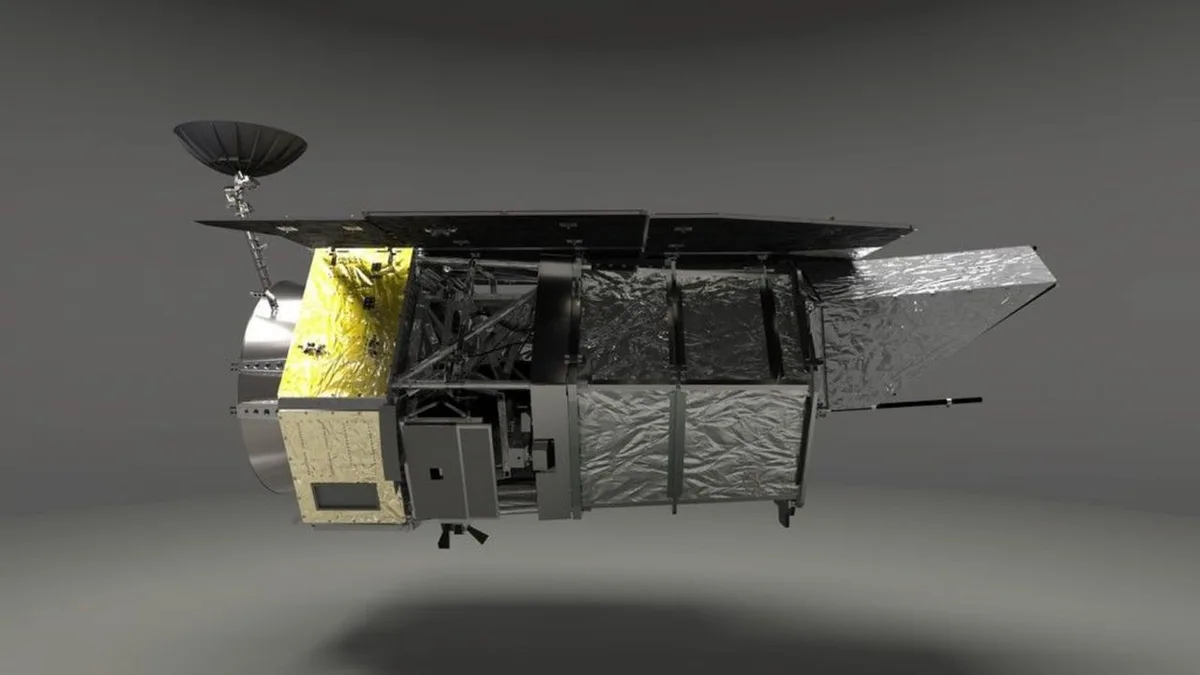
The instruments that will make this mission possible are tucked inside the observatory that looks, oddly enough, like a helicopter frozen mid-flight.
With a nose-like front end housing the telescope, a pair of flat solar panels stretched out to either side and an antenna perched on top, the resemblance turns out to be a handy way to understand the key instruments that make Roman's mission possible.
The telescope Just like a helicopter's nose holds critical navigation and visibility instruments, the front of Roman is home to the telescope, which gathers starlight and sends it to the science instruments behind.
At the heart of the telescope is a primary mirror 7.9 feet (2.4 meters) across, the same size as Hubble's, while a smaller secondary mirror that's just under 2 feet (0.5 meters) wide sits in its front.
Both mirrors are kept cold, chilled to about 19 degrees Fahrenheit (-7 degrees Celsius), to prevent heat from the telescope itself from interfering with observations, according to NASA .
A diagram showing the Roman Space Telescope and its various instruments. (Image credit: NASA Goddard Space Flight Center Scientific Visualization Studio) The telescope is also kept in optimal optical working condition with the help of the Deployable Aperture Cover, or DAC.
Located at the very front of Roman, this hat-like shade pops open once the observatory reaches orbit, blocking stray light from entering the telescope barrel and helping protect the telescope's sensitive optics throughout the mission.
Solar Array Sun Shield A helicopter's wings would look a lot like the flat panels stretched out on either side of Roman — except these panels are built for power, not lift.
5News aggregated this summary from the outlet’s public feed. The full article, with all the context, is on www.space.com — the content belongs to Space.com.