Water can survive surprisingly close to the Milky Way's supermassive black hole, James Webb Space Telescope finds
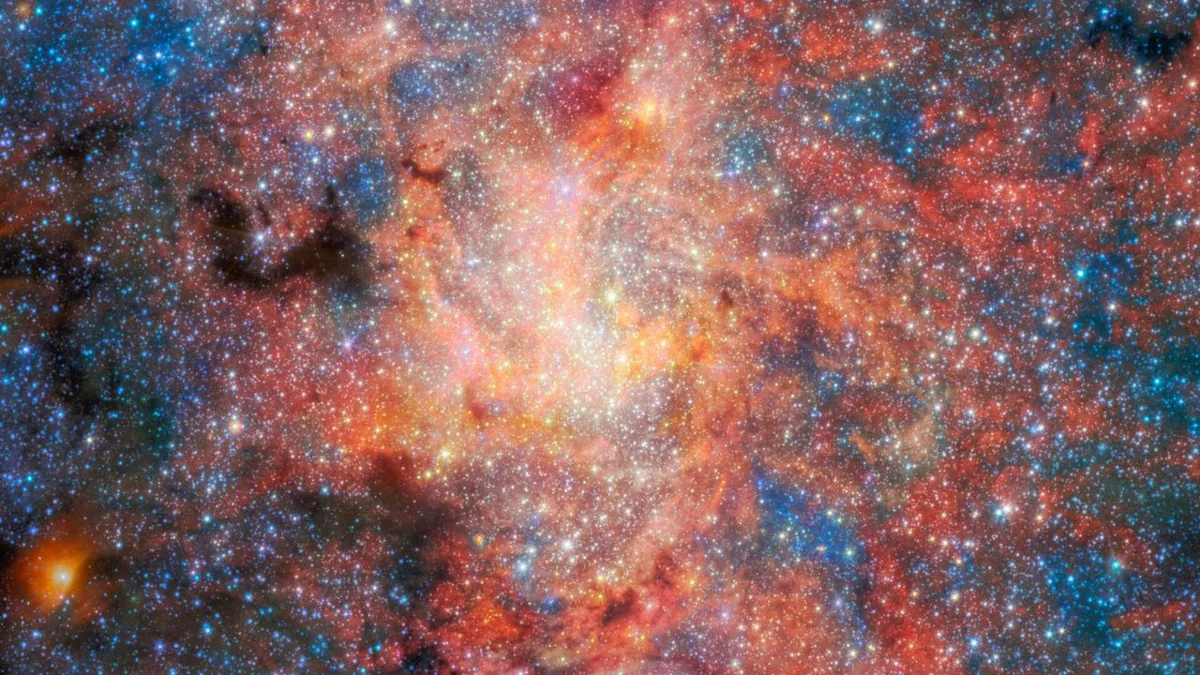
The heart of the Milky Way may be more hospitable to water than astronomers thought.
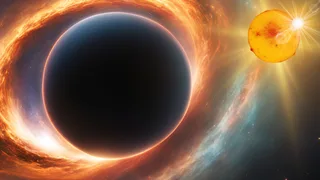
Using the James Webb Space Telescope (JWST), researchers detected water and cosmic dust around an aging star only 0.55 light-years from Sagittarius A* (Sgr A*), the supermassive black hole at the center of our galaxy.
The new study suggests that water and dust can form and survive surprisingly close to a supermassive black hole , where intense radiation and other harsh conditions might otherwise be expected to destroy them.
The team used Webb's Mid-Infrared Instrument (MIRI) to study IRS 3, an aging star located in the crowded environment surrounding Sgr A*, which has a mass of about 4 million suns, according to a statement from the European Space Agency (ESA). (Image credit: ESA/Webb, NASA & CSA, F.
Peißker, J.
Lu, F.
Yusef-Zadeh, N.
B.
Sabha, C.
Chan) "Galactic centres are among the most extreme environments, so understanding whether stars can continue enriching their surroundings there is an important question," Florian Peißker, lead author of the study from the University of Cologne in Germany, said in the statement .
"With Webb, we can directly observe how stars behave under these conditions and see that dust production remains remarkably resilient." IRS 3 — one of the brightest mid-infrared sources in the galactic center — is an asymptotic giant branch star , meaning it has reached a late stage of stellar evolution in which it sheds large amounts of gas and dust through powerful stellar winds.
Such dying stars act as cosmic recycling centers, returning material to space that can eventually become incorporated into future generations of stars and planets.
But IRS 3 lives in a particularly unforgiving neighborhood.
The center of the Milky Way is densely packed with stars and exposed to intense radiation, raising questions about whether molecules and newly produced dust can persist there.
5News aggregated this summary from the outlet’s public feed. The full article, with all the context, is on www.space.com — the content belongs to Space.com.