Mammal ancestors may have given live birth 90 million years earlier than we thought, rewriting evolutionary timelines
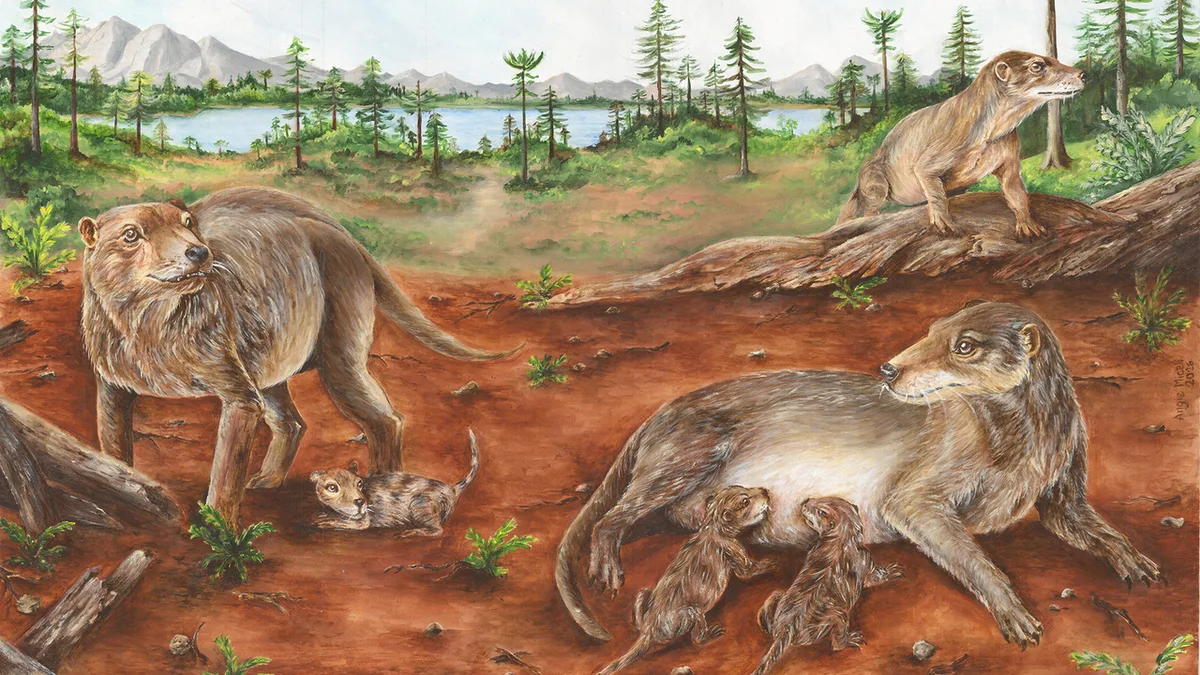
A dog-sized carnivore and mammal ancestor that lived around 236 million years ago seems to have given birth to live young, a new study suggests.
This means the tactic of keeping young developing inside the mother — known as viviparity — may have emerged in the mammalian lineage 90 million to 95 million years earlier than scientists previously thought, researchers noted in the study.
"This is the first time that we have evidence on how these mammalian ancestors reproduced," said first author Leandro Gaetano , a paleontologist at Argentina's National Scientific and Technical Research Council.
His team reported the findings Aug.
13 in the journal Frontiers in Mammal Science .
Mammals, along with their extinct ancestors and close relatives, belong to the Cynodontia clade, which first appeared about 260 million years ago, in the Late Permian period.
But after the Great Dying extinction event 252 million years ago, which heralded the start of the Triassic, the cynodonts flourished.
Gaetano and his colleagues spotted a curious growth mark in a fossilized bone of Chiniquodon theotonicus is, a carnivorous, dog-sized cynodont that lived some 236 million years ago in what is now northwestern Argentina.
Data from living species suggested the mark was a growth ring of disorganized bone material known as neonatal line, which forms when growth rapidly accelerates just after birth or hatching.
These marks are common in the bones of living terrestrial animals, Gaetano said.
"When you are in an egg or in your mom's belly, you have a small space and you grow very slowly," he told Live Science.
"When you hatch or are born, you have a lot of space and you start growing very, very quickly." To try to discern how the youngster emerged, the team measured the neonatal line and overall size of adult C . theotonicusis leg and arm bones to estimate that the individual weighed about 26 pounds (12 kilograms) when it died and about 3.7 pounds (1.7 kg) when it was born — about 14% of its adult mass.
Then, the team compared these values to those of 1,869 mammal species, 2,619 nonavian reptiles and 782 birds alive today.
Zooming in on those of comparable weight, the team found that the reptiles — including snakes, turtles and crocodilians — that weigh between 17.6 and 32 pounds (8 to 14.5 kg) a produce hatchlings that are just 0.1% to 0.6% of their adult mass.
5News aggregated this summary from the outlet’s public feed. The full article, with all the context, is on www.livescience.com — the content belongs to Live Science.