Why Trump’s Latino voters are fleeing him
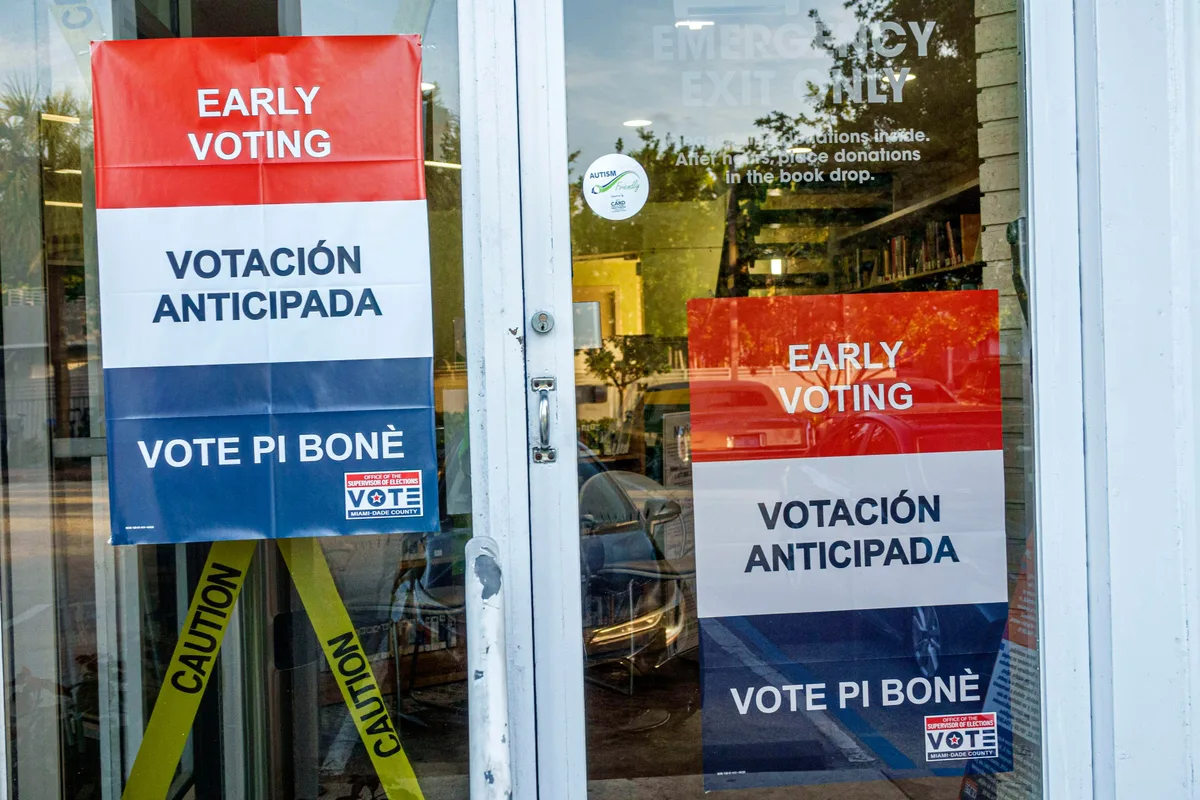
Early voting signs on the doors of the Miami Beach North Shore Branch Public Library in Miami Beach, Florida, on December 7, 2025. | Jeffrey Greenberg/Universal Images Group via Getty Images In 2024, Donald Trump’s victory was powered in large part by massive gains with Latino voters .
He won 48 percent of those voters that year, up from 36 percent in 2020 and 28 percent in 2016.
But now, that support is plummeting; Trump’s approval rating among Latinos who voted for him recently fell from 93 percent to 66 percent , where it was at the beginning of his second term.
Why? It has a lot to do, as with everything these days, with the economy.
It was the same in 2024.
During that election, voters were experiencing rising costs and stagnant wages — the same trend that has continued until today.
In 2024, though, Joe Biden and his administration — which also meant Vice President Kamala Harris — took the blame from all voters, and particularly Latinos .
Today, the blame is falling on Trump.
America, Actually host Astead Herndon caught up with Stephanie Valencia, who co-founded Equis Research, a political research firm that specializes in Latino voters, to unpack some of these recent shifts and explain them.
“I think one important data point to understand about the Latino voter is Latinos make up more of the wage workforce than any other part or any other racial subgroup,” she said on the podcast.
“And so what that means is when wages are down and inflation is high, Latinos feel it more.” That’s why, when the economy is bad, this group is primed to be a “swinging giant” in US politics, Valencia explains — and right now, it appears to be swinging hard against Trump.
Below is an excerpt of the conversation, edited for length and clarity.
There’s much more in the full show, so listen to America, Actually wherever you get your podcasts or watch it on Vox’s YouTube channel .
Equis has called Latinos one of the last great wild cards in American politics.
5News aggregated this summary from the outlet’s public feed. The full article, with all the context, is on www.vox.com — the content belongs to Vox.