Antarctica’s penguins are sending us a distress signal
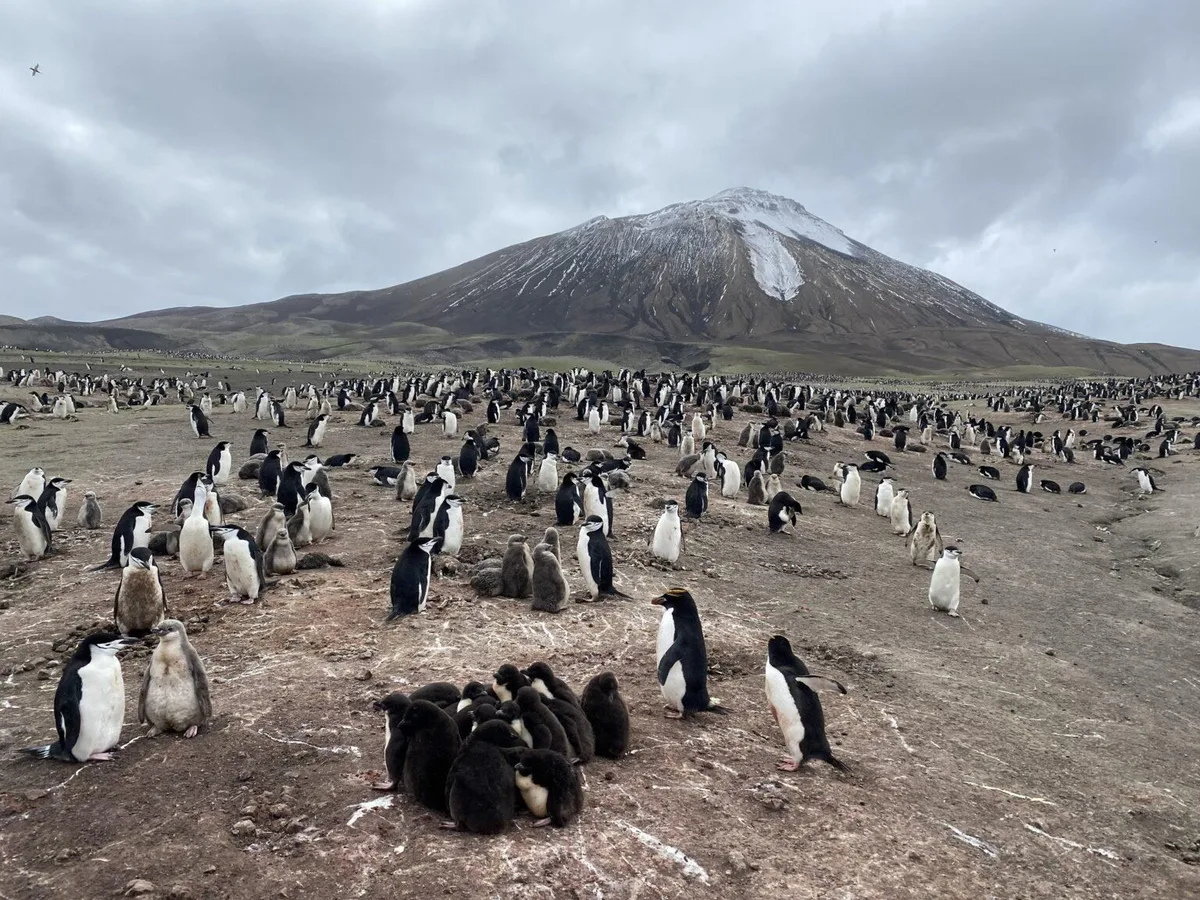
Chinstrap and macaroni penguins nesting on the volcanic slopes of Zavodovski Island. | Nicole Richters via British Antarctic Survey This story was originally published by The Guardian and is reproduced here as part of the Climate Desk collaboration.
The world’s largest penguin colony has declined by two-thirds since 2011, most likely because of the climate crisis, a study has revealed.
Scientists said the rapid demise of chinstrap penguins on Zavodovski, the northernmost of the South Sandwich Islands in Antarctica , increased the risk of a wider ecosystem collapse.
“It is an enormous population crash, equivalent to half a million breeding individuals being lost from that island,” said the leader of the research, professor Norman Ratcliffe, a penguin ecologist at the British Antarctic Survey .
The Guardian reported in 2020 that chinstrap penguin populations were decreasing on Low in the South Shetland Islands, prompting concerns among scientists that “something is broken” in the world’s wildest ecosystem.
The new study, published on Wednesday in the journal Current Biology , indicates that the speed of collapse may be accelerating so rapidly that the distinctive bird — which gets its name from a black line that runs below the beak from cheek to cheek — may need to be classified as an endangered species.
Zavodovski Island had by far the biggest penguin colony in the world, with about 600,000 chinstraps and 90,000 macaroni penguins when the population was measured in 2011.
Given the decline between then and 2025, it is likely to have lost that title to Cape Adare in the Ross Sea.
Scientists believe the most likely cause is climate disruption.
Human-driven heating has pushed up winter temperatures on and around the Antarctic Peninsula to 5 degrees Celsius above preindustrial levels, one of the fastest rises in the world.
On 6 June, the Argentinian Esperanza base on the Trinity Peninsula registered a record winter high of 15.4°C, about 20°C above normal for the time of year — a margin that scientists described as “absolutely crazy.” Chinstrap penguins are struggling to adapt because they have special diets and specific ocean temperature preferences.
Tracking data shows they prefer to forage in cooler waters to the northwest of the island, where they would expect to find Antarctic krill, which make up the bulk of their diet.
But as the waters warm, the krill have moved south into the Weddell Sea.
Macaroni penguins, by contrast, are less fussy eaters and their numbers rose 30 percent — though not nearly enough to make up for the loss of chinstraps.
5News aggregated this summary from the outlet’s public feed. The full article, with all the context, is on www.vox.com — the content belongs to Vox.