SpaceX rocket's moon crash highlights 'a tangible operational risk' of lunar settlement
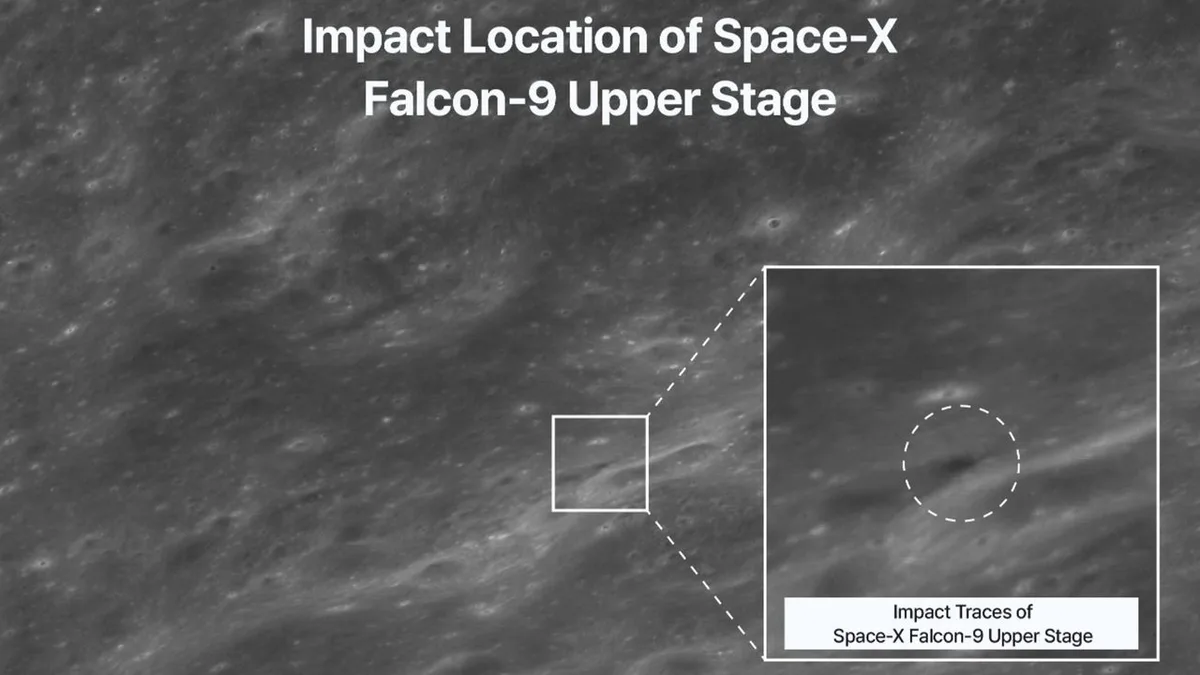
The moon dust has settled after a 4.5-ton SpaceX rocket body slammed into terrain near Einstein Crater on Aug.
5.
That impact site was imaged by South Korea's moon-orbiting Danuri spacecraft, as well as by NASA's Lunar Reconnaissance Orbiter (LRO).
Reportedly, a Chinese commercial space debris monitoring satellite tracked and recorded the 5,400-mph (8,690-kph) moon punch, too.
Wandering through space for over a year, the leftover Falcon 9 upper stage had sent Firefly Aerospace's Blue Ghost-1 lander on its way to the moon back on Jan.
15, 2025.
Also sent moonward on that flight was the Hakuto-R Mission 2's Resilience, a robotic lunar lander developed by the Japanese company ispace.
While the moon has reclaimed its serenity, the implications of the uncontrolled collision continue to reverberate.
Close encounter Interestingly, there was also the prospect of a too-close-for-comfort conjunction of the Falcon 9 upper stage and Danuri.
"We noticed roughly late June that there is an incoming Falcon 9 upper stage toward the moon, and also knew that it would be close to Danuri," Eunhyeuk Kim, a senior researcher at the Korea Aerospace Research Institute (KARI), told Space.com.
There was a huge uncertainty in the predicted trajectory of the upper stage, Kim said, while the orbit information of South Korea's Danuri lunar orbiter was quite accurate.
"Therefore, we could not neglect the probability of an incoming and close encounter." Before-and-after imagery of the impact site. (Image credit: KARI) Spacecraft maneuver However, around mid July, the KARI/Danuri team performed a maneuver of the spacecraft in preparation of a near-total lunar eclipse on Aug.
28, said Kim.
That eclipse will see 96% of the moon's visible surface passing through Earth's dark umbral shadow.
5News aggregated this summary from the outlet’s public feed. The full article, with all the context, is on www.space.com — the content belongs to Space.com.