Scientists create largest 2D map of the universe with 5.6 trillion pixels and nearly 4 billion cosmic objects
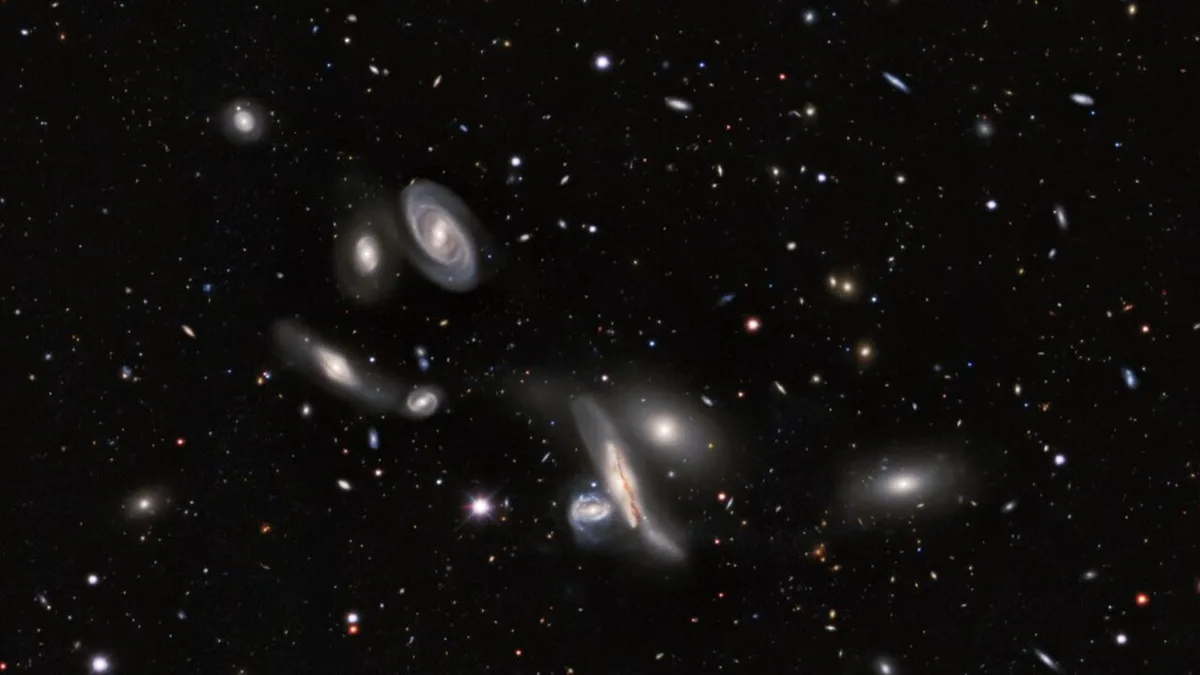
Astronomers have released the largest two-dimensional map of the universe ever created, offering a sweeping new view of nearly 4 billion celestial objects across roughly three-quarters of the sky.
The new map, created by the Dark Energy Spectroscopic Instrument (DESI) Legacy Imaging Surveys team, contains a staggering 5.6 trillion pixels and combines more than 263,000 telescope exposures collected over more than a decade.
The observations span visible and near-infrared wavelengths, providing an enormous portrait of stars, galaxies and other cosmic phenomena across the sky, according to a statement from the National Science Foundation (NSF) NOIRLab. (You can explore the full data here .) "It's part of the fabric of astronomy research now," David Schlegel, co-lead of the Legacy Surveys and a scientist at the U.S.
Department of Energy's Lawrence Berkeley National Laboratory, said in the statement .
"When you're working with astronomical objects today, you often start by pulling up the Legacy Imaging Viewer to see what you're looking at." The latest 2D cosmic map represents the culmination of 13 years of observations and data processing.
The Legacy Imaging Surveys were originally designed to help DESI determine where to point its thousands of robotic optical fibers, essentially creating the 2D foundation for DESI's much larger effort to map the universe in three dimensions.
Installed on the Nicholas U.
Mayall 4-meter Telescope at Kitt Peak National Observatory in Arizona, DESI measures the spectra of galaxies and quasars .
By determining their redshifts — how much their light has been stretched as the universe expands — astronomers can calculate their distances and transform a flat view of the sky into a 3D map of the cosmos.
DESI began its main survey in 2021 with the goal of tracing how the universe has expanded over billions of years and, in turn, helping scientists better understand dark energy , the mysterious phenomenon thought to be driving that expansion.
The project has since far surpassed its original targets.
By April 2026, DESI had mapped more than 47 million galaxies and quasars, creating the largest high-resolution 3D map of the universe to date.
Previous DESI results have also provided intriguing evidence that dark energy may evolve over time rather than remain constant, as predicted by the standard model of cosmology.
Among the nearly four billion objects in the DESI Legacy Imaging Surveys' map is Messier 96 (NGC 3368), a majestic spiral galaxy nestled in the constellation Leo approximately 35 million light-years from Earth. (Image credit: DESI Legacy Imaging Surveys/LBNL/DOE & KPNO/CTIO/NOIRLab/NSF/AURA) DESI isn't the only project finding new ways to map the cosmos.
5News aggregated this summary from the outlet’s public feed. The full article, with all the context, is on www.space.com — the content belongs to Space.com.