A photon from the biggest cosmic explosion since the Big Bang appears to have defied Einstein. Scientists may finally know how
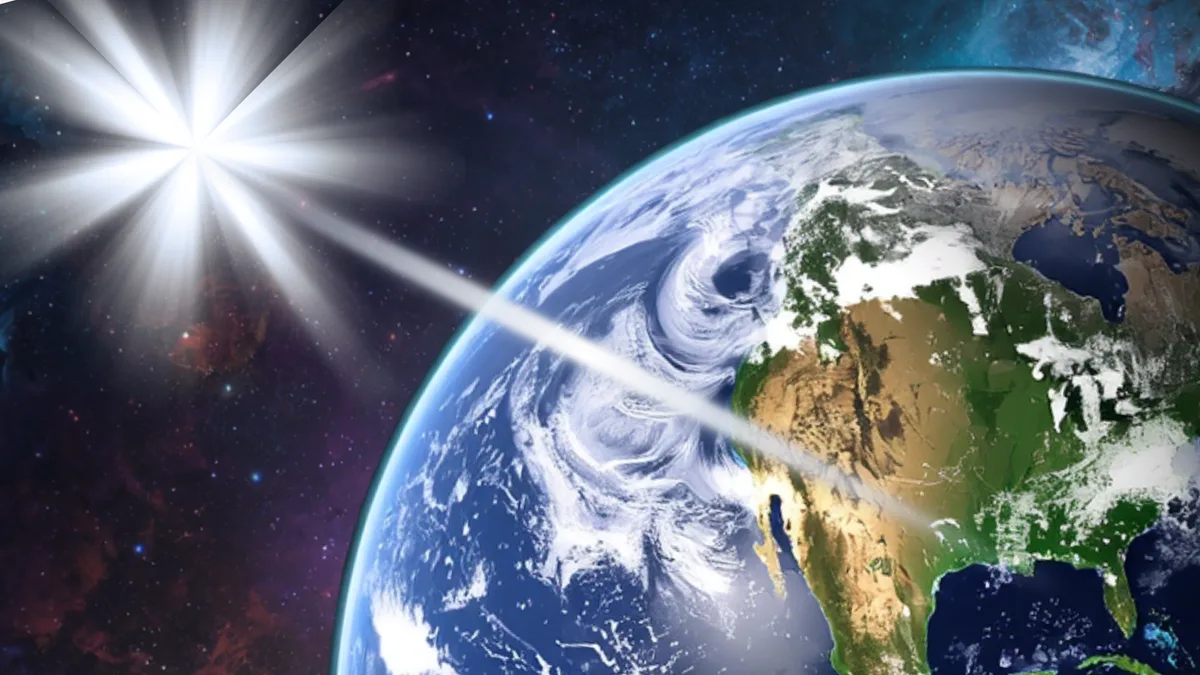
A photon, or particle of light, from the biggest cosmic explosion since the Big Bang, nicknamed "the BOAT" (for the brightest of all time), should not have reached Earth.
That is, unless it defied rules defined by Einstein.
Now scientists may know how it did this, with new research suggesting how the high-energy photon may have survived a journey of more than two billion light-years without being absorbed.
The BOAT, a gamma-ray burst officially designated GRB 221009A , was first detected on Oct.
9, 2022.
Among the ocean of photons from the event that rained down on our planet was the highest-energy photon ever detected originating from a gamma-ray burst.
It was detected by Carpet, an ultra-high-energy cosmic-ray detector located at the Baksan Observatory in the Russian Caucasus.
The problem is, according to all current rules of physics, a particle with such high energy shouldn't reach Earth from an explosion occurring such a vast distance away.
That's because space isn't empty; it is filled with a "fossil" radiation field of photons left over from just after the Big Bang called the cosmic microwave background (CMB).
It should be virtually impossible for a high-energy photon to travel 2 billion light-years without interacting with a CMB photon and being transformed.
And still it came.
"We started from a very simple question: how did this photon survive a journey that, according to known physics, should have destroyed it?" team leader Giorgio Galanti from the Italian National Institute for Astrophysics (INAF) said in a statement.
"The new data from the Carpet experiment showed us that the explanations proposed so far were no longer sufficient.
"We therefore looked for a theoretical scenario capable of consistently describing what we observe, without resorting to arbitrary corrections to the equations." A hypothetical transformation To investigate the mystery of how this high-energy photon reached our planet, Galanti and colleagues turned to incredibly light hypothetical particles called axion -like particles (ALPs).
5News aggregated this summary from the outlet’s public feed. The full article, with all the context, is on www.space.com — the content belongs to Space.com.