'Freakish' discovery of 9 million-year-old capybara tooth supports idea that Atacama wasn't always a desert
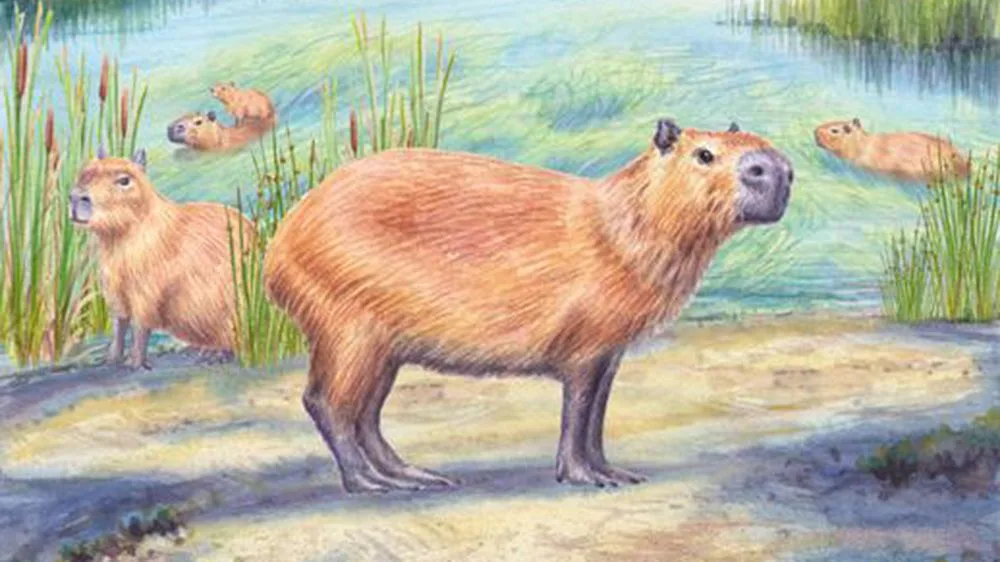
An illustration of ancient capybaras enjoying coastal wetlands, which may have looked somewhat like the Atacama Desert around 9 million years ago. (Image credit: Mauricio Alvarez) Researchers have discovered a roughly 9 million year old tooth belonging to a large, water-loving relative of modern day capybaras in the Atacama Desert of northern Chile.
The fossilized molar adds to previous evidence suggesting that it's unlikely the Atacama, one of the driest places on Earth, was continuously dry for the last 40 million years.
The Atacama Desert , possibly the oldest desert on Earth, takes up the northern third of Chile.
It's bounded by the Chilean Coast Range to the west, which blocks rain from the Pacific Ocean, and the enormous Andes to the east, which obstruct rain from the Atlantic Ocean.
The driest part of the desert's hyperarid region gets less than 0.08 inches (2 mm) of rainfall a month.
Recent research estimates the Atacama's hyperarid core started forming between 47.8 million and 33.9 million years ago, in the Mid- to Late-Eocene, 20 million years before the Andes formed.
It suggests the mountain ranges weren't the cause for the desert's aridification, and may have only intensified it.
Capybaras ( Hydrochoerus hydrochaeris ) — the world's largest rodent — exclusively live close to stable freshwater sources and feed on plants that also require water to grow, so the discovery of an extinct capybara relative ( Hydrochoerus Cardiatherium ) tooth in the Atacama Desert is very strange.
"Finding a capybara tooth in a marine deposit in what today is one of the driest regions on Earth is just freakish," Priscilla Martinez , a geoscientist at the University of Arizona and co-author of a new paper describing the discovery, said in a statement .
Capybaras are native to South America, although today, they are not found in Chile, where the tooth was unearthed, according to the International Union for Conservation of Nature (IUCN).
Part of the Atacama Desert called Valle de La Luna, named because of the region's resemblance to the moon. (Image credit: Piero Damiani via Getty Images) The tooth isn't the only clue that the Atacama was a wetter place in the late Miocene.
Researchers found it in a layer holding the remains of a shallow marine environment that existed between 7 million and 10 million years ago, according to the statement.
And they've also found microscopic pieces of plants, known as phytoliths, revealing that palm trees, grasses, gingers and other flowering plants grew there in what may have been a subtropical forest.
These findings and others are part of a growing body of evidence that the Atacama Desert was once wet enough for crocodiles and freshwater fish to thrive and palms to grow.
5News aggregated this summary from the outlet’s public feed. The full article, with all the context, is on www.livescience.com — the content belongs to Live Science.