'No longer will anything seem impossible or marvellous': How an 'immoral, foul-mouthed and violent man' wrote the first eyewitness account of a total solar eclipse
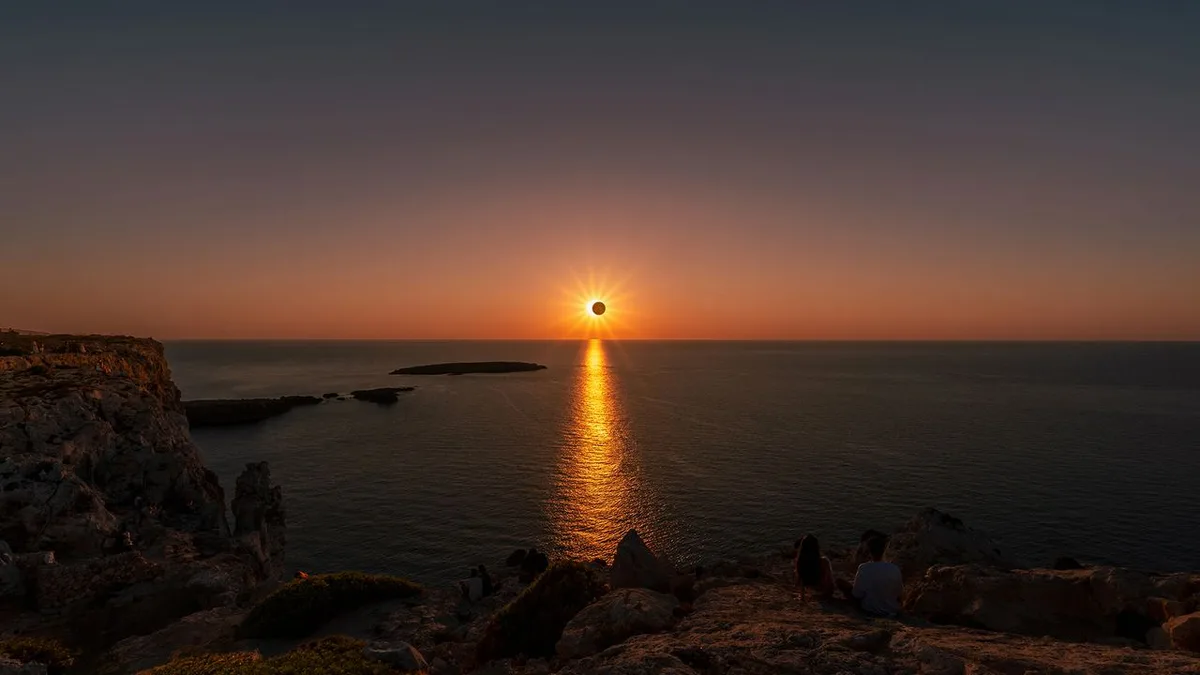
Though the spectacular sight of a total solar eclipse feels like a rare experience, on a planetary scale, the average time between two such events is just 18 months , with some occurring much closer together.
Now, thanks to centuries of studying the orbit of the sun and moon, we are able to correctly predict when and where the next eclipse will be far into the future .
But for thousands of years of human culture, the lunar crossing of the sun remained as mysterious in cause as it did in location.
In his book " Solar Eclipses " (Reaktion books, 2026), writer and historian of astronomy William Sheehan goes back to ancient times to discover what impact this awe-inspiring celestial dance between the sun and the moon had on ancient civilizations, and how over time we began to understand the science choreographing it.
This excerpt from the book goes as far back as ancient Greece, where we learn of the "immoral, foul-mouthed and violent" soldier and poet Archilochus, who gave us the first written account of a total solar eclipse.
Today, with the ability to predict the paths of eclipses to extremely high accuracy, to make quite successful long-range (ten days or more) weather forecasts, ease of travel and for many, plus a significant amount of discretionary income that never existed in previous times, seeing eclipses has become a passion for thousands of global eclipse-chasers.
People seek out a connection with the larger universe that includes a huge rush of adrenaline and life-transforming emotions that have been described as "spiritual" in nature.
Of course, eclipses have occurred since time immemorial, but until recent times people have experienced them on a somewhat haphazard basis.
This is emphatically the case with total solar eclipses, which, despite being the most stunning, are rare from any given place and could hardly be expected (before eclipse prediction and travel became more convenient) to be seen in a human lifetime.
The reason for this is that the central (umbral) shadow of the Moon that creates the totality zone is so narrow —– only 200 kilometres (124 miles.) on average —– so that it mostly falls on uninhabited portions of Earth's surface.
From any one location, totality might not occur at all during a person's lifetime.
The 30 June 1954 total eclipse, for instance, was the last visible from Minneapolis until that of 14 September 2099; the 22 July 2028 eclipse visible from Sydney will be the last visible from there until 3 June 2858 (!) and so on.
People working in fields or hunting and fishing have little incentive to stare at the Sun.
The actual width of the direct path of the shadow (known as the antumbra at annular and umbra at total eclipses) can vary from 0 kilometres to more than 1,000 kilometres (620 miles).
5News aggregated this summary from the outlet’s public feed. The full article, with all the context, is on www.livescience.com — the content belongs to Live Science.