What Trump’s Bizarre Posts Are Teaching Us About AI
Here is a selective list of the dozens of images the president has recently disseminated on Truth Social: Donald Trump on a horse next to George Washington on a horse, in the body of Hulk Hogan, beating Hogan in arm wrestling, standing between General George Patton and General Douglas MacArthur in a World War II uniform, hovering menacingly with a hockey stick over the Canadian prime minister, commanding the deck of an aircraft carrier, nuking parts of Earth from space, gleefully dancing to “YMCA” as he replaces a sign for Lake Ontario with one for Lake America.
Maybe most surreal (though, admittedly, kind of funny), he posted a video of a squad of “Donald Ducks” with his signature hair, armed with machine guns, waddling in formation to protect said lake.
Trump has never been shy about his proclivity for self-aggrandizement (daydreaming about having his face chiseled onto Mount Rushmore or printed on a $250 bill).
But his recent spate of social-media posts—almost all products of AI—has him living in an expanded fantasyland.
His supporters are likely to just giggle; more fun and trolling—so what? His critics might roll their eyes at the extravagant immaturity but almost can’t be bothered anymore (unless they’re Iceland ).
After a decade of Trump shenanigans, getting worked up either way is hard.
Also, these images might come across as just a little sad—the projections of a man who is losing power and virility but desperately needs to see himself as powerful and virile.
The absurd cartoons are worth pondering, though, and not for the sake of getting to know Trump better (I believe that onion has been thoroughly peeled).
Because what AI can do to exaggerate and aggrandize Trump, it can do to everyone.
For the president, this may be just one more level up on his escalator of self-regard, but for those without Napoleonic degrees of narcissism, the mental terrain opened up by these quick-prompt chimeras is new.
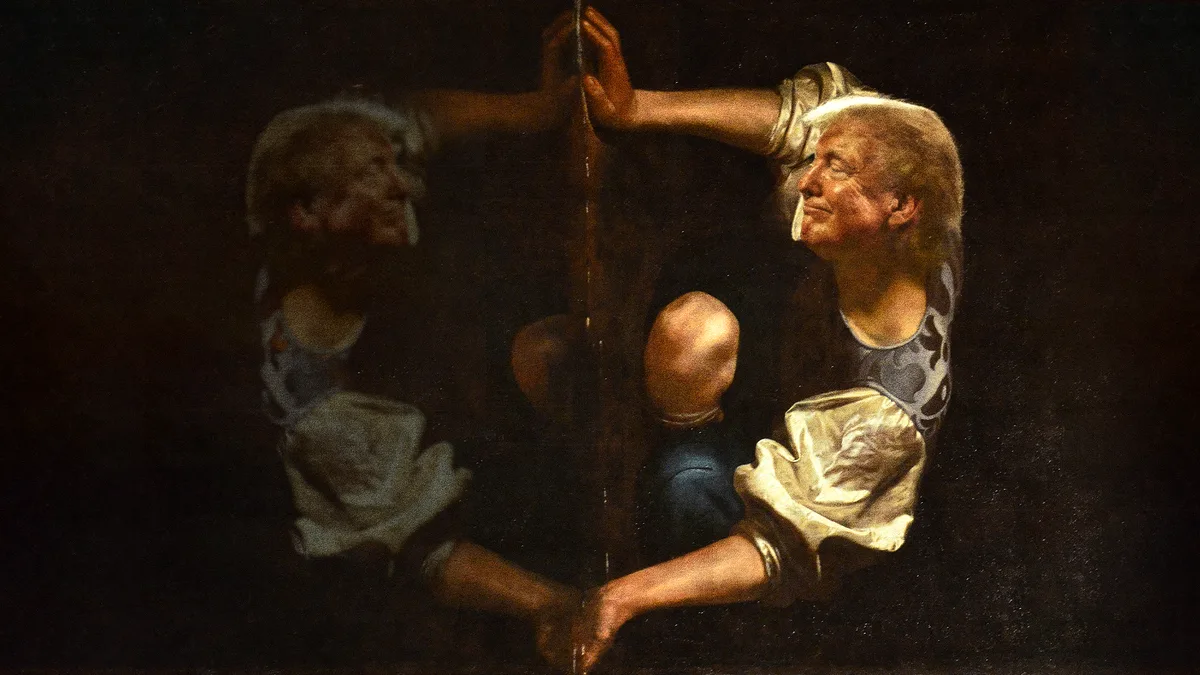
When the psychoanalyst Jacques Lacan wanted to understand how the ego takes shape, he thought of mirrors.
Sometime from six to 18 months of age, he theorized, a baby begins to recognize their reflection, and experiences what Lacan—abstruse French structuralist that he was—described as the “jubilant assumption of his specular image.” In plainer words, the baby realizes, That’s me! This is significant because the child at this point is otherwise a fragmented mess, experiencing the world through disconnected sensation.
Lacan thought the mirror provides an idealized perception of wholeness when, really, inside it’s all a scramble, and through this illusion of coherence, a proper ego—a sense of self—begins to bud.
5News aggregated this summary from the outlet’s public feed. The full article, with all the context, is on www.theatlantic.com — the content belongs to The Atlantic.