The moon could turn astronauts into 'walking, high voltage capacitors' that accidentally zap spacecraft
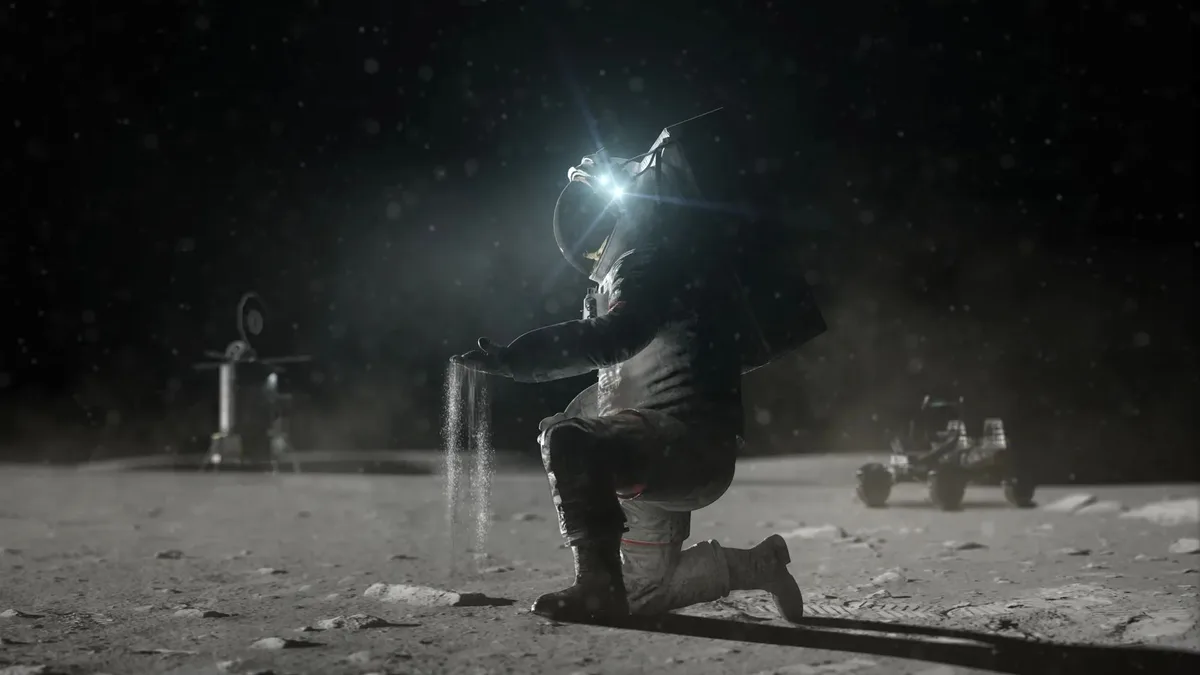
NASA is asking for ideas to stop static electricity from zapping astronauts or critical hardware during moon missions.
The agency opened a "Lunar Grounding Challenge" to avoid situations where an astronaut on the moon could become "a walking, high voltage capacitor." Submissions for the $150,000 competition are due Jan.
15 and you can see the requirements here .
NASA is hoping to put astronaut boots at the lunar south pole in 2028 during the Artemis 4 or 5 missions, on the first landing mission since NASA's Apollo 17 in 1972.
But simulations suggest that both "tribocharging" (electric-charge transfer between two objects) and plasma charging (from ambient gas in the region) could build up electric charge on spacesuits.
"This problem is severely compounded when entering lunar shadows and permanently shadowed regions," the agency wrote, referring to deeply cratered areas where the sun does not touch the lunar surface.
The concern is that astronauts' spacesuits could become electrically charged, as there would be an excess of electrons (negatively charged particles) compared with ions (positively charged) in these areas.
"The risk occurs when an astronaut returns to the spacecraft," the agency added.
The lander would have a slight positive charge, producing an issue once the "highly negatively-charged astronaut approaches the vehicle." NASA has asked industry partners for ideas that can help an astronaut avoid "becoming a walking, high voltage capacitor", including issues such as an electrical arc that could damage spacesuits, spark fires in the oxygen atmosphere of a spacecraft, or create electrical shocks. (A Mars simulation in 2018 was reportedly derailed due to a crew experiencing electrical issues, so this problem is not unprecedented.) The challenge aims to create designs that would safely discharge the astronaut and their spacesuit before an astronaut touches the lander.
Among the technical requirements, NASA is looking for something small (in terms of mass, volume and power) that would be able to operate even in the extreme temperature swings of the lunar surface.
The technology must also be able to help as many as four extra-vehicular activities (moonwalks) that take place over as long as 10 days.
"In addition, the suspended lunar dust and heavy dust buildup on a suit in these environments significantly increases arcing lengths, allowing sparks to jump across larger gaps than they would in a clean vacuum.
Therefore, the solution must aim to avoid a sudden arc that may come into contact with the outer pressure garment — suit — or the lander," NASA wrote in the challenge description.
The challenge will include multiple phases, including a concept design, concept refinement after chatting with reviewers, and then a final selection.
5News aggregated this summary from the outlet’s public feed. The full article, with all the context, is on www.space.com — the content belongs to Space.com.