1,200-year-old burial in Latvia holds people who died of 'sharp force' injuries, possibly from a Viking raid
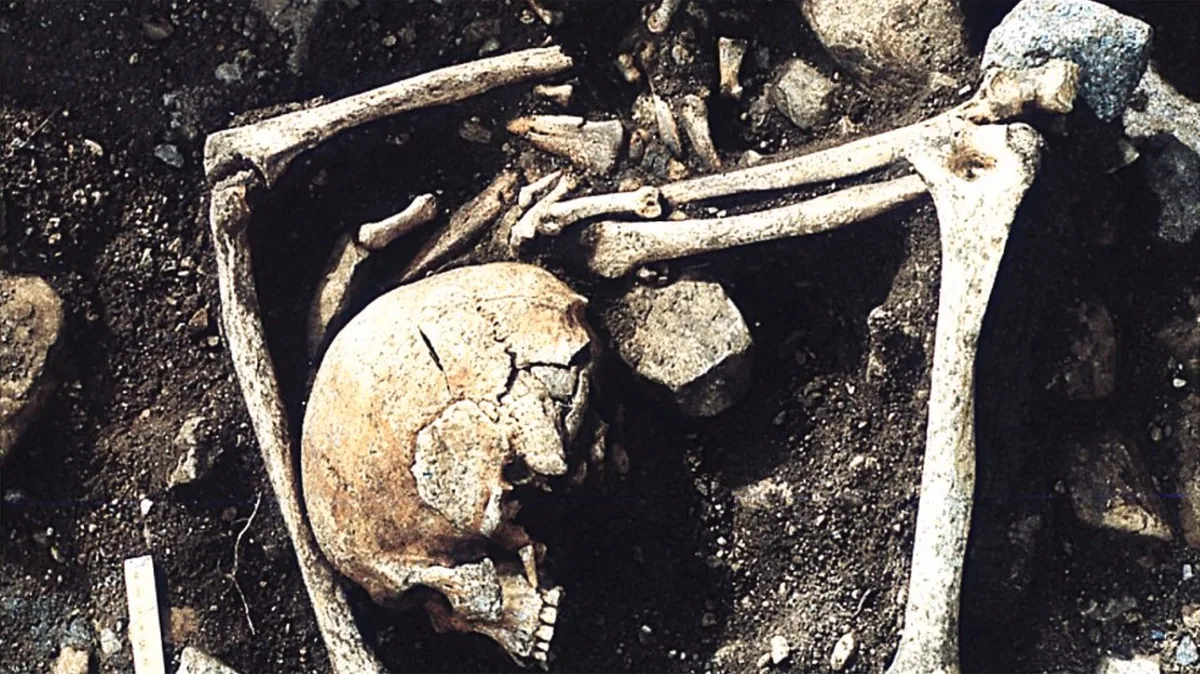
Six people buried in a single grave in Latvia more than 1,000 years ago may have been killed in a bloody Viking raid, a new study suggests.
Genetic research into the deceased — four men, a boy and a girl — reveals family connections: The boy was the son of one of the men, while another man was a third-degree relative, perhaps a first cousin or great uncle, the researchers found.
The father, the relative, and one other man died from "sharp force" injuries — maybe wounds from an ax or a sword; but it's unknown how the other three individuals died, the researchers reported in the study, which was published in the September issue of the Journal of Archaeological Science: Reports .
One possibility is that those in the grave were killed in a battle, maybe with a neighboring community.
But suspicion also falls on the Vikings: "We will never know if they were killed in a raid, but it remains a possibility because of the date of the grave" and the fatal trauma suffered by three of the men, said study co-author Elīna Pētersone-Gordina , an archaeologist at the University of Latvia.
Radiocarbon dating indicates that the grave is from the second half of the ninth century, which is considered the early Viking Age .
The grave is one of hundreds at the Čunkāni-Dreņģeri cemetery, near the Gulf of Riga, a sheltered bay of the Baltic Sea.
The cemetery site was discovered in 1924 and contains people who were buried in riverside terraces there between the seventh and 11th centuries, during Latvia's Iron Age.
Most graves in the region contain only a single set of remains.
But here, six people were buried in a single grave, and it seems that at least three were killed during a violent event, the researchers reported.
Strange burial Despite the apparently violent deaths, the group was buried with care and interred with traditional grave goods and according to local customs.
The only female was buried with her head pointing toward the northwest, while all of the males were placed in a row beside her, with their heads pointing toward the southeast — a distinction also seen at other local burials from this time.
The researchers stressed that this was not a "mass grave," where bodies were quickly dumped without order.
Instead, they consider it a "multiple burial," where each body was properly laid out and accompanied by traditional grave goods.
5News aggregated this summary from the outlet’s public feed. The full article, with all the context, is on www.livescience.com — the content belongs to Live Science.