A starquake 10 billion years ago may have just sent a flash to Earth
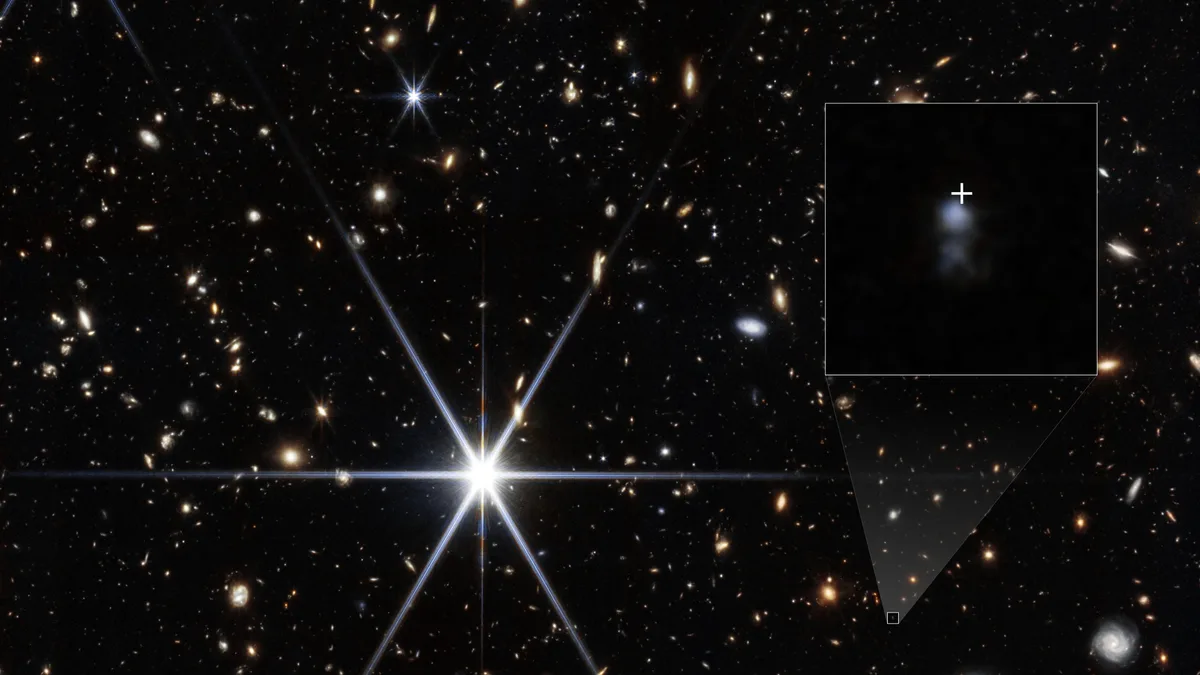
A split-second flash of radio waves traveled through space for more than 10 billion years to reach Earth, making it the farthest fast radio burst anyone has detected and confirmed.
Fast radio bursts, or FRBs, last only a few thousandths of a second but release enormous amounts of energy.
Scientists spotted the first one in 2007, and they still don't know what causes them.
Most flash only once, which makes them extremely hard to chase.
South Africa's MeerKAT radio telescope caught this one, dubbed FRB 20240304B, on March 4, 2024.
After failing to find its origin with the world's largest ground-based telescopes, the team, led by Manisha Caleb and Themiya Nanayakkara of the University of Sydney in Australia, turned to NASA 's James Webb Space Telescope .
Finally, it came into focus: a faint galaxy from when the universe was only about 3 billion years old — more than double the distance of the prior record.
Until now, astronomers mostly managed to find and measure the sources of bursts much closer to home.
This one shows researchers can trace bursts much farther back in time, turning them into tools for exploring the early universe .
SEE ALSO: Mars' weird 1,100-mile cloud runs on physics no one has ever seen before The galaxy itself surprised the team.
Most bursts come from big galaxies, but this one has about 1,000 times less mass than expected.
The researchers have published their findings in the journal Science .
"We thought it would be a big, nicely formed galaxy with lots of stars, and instead it was a little dwarf galaxy, although it was actively forming stars," Caleb said.
The MeerKAT radio telescope in South Africa detected the fast radio burst on March 4, 2024.
5News aggregated this summary from the outlet’s public feed. The full article, with all the context, is on mashable.com — the content belongs to Mashable.