Massive space mirrors could be 40 times brighter than the full moon, astronomers warn. 'It will be worse than big cities like London'
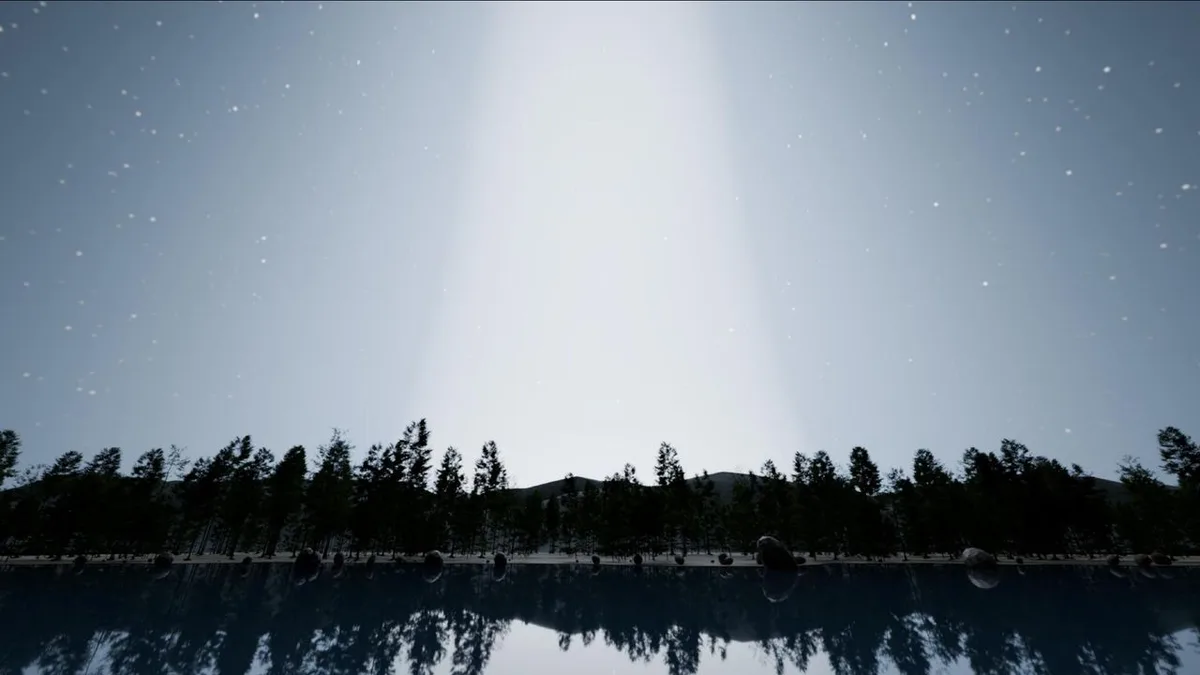
Each of the sun-reflecting mirrors proposed by U.S.-based startup Reflect Orbital will appear 40 times brighter than the full moon to observers standing within its beam on Earth, a study has found.
The light pollution produced by each of those mirrors would completely wipe out stars from the sky for those underneath them, turning the starry night into an eerie twilight zone.
"It will be worse than big cities like London," Gaspar Bakos, a professor of astrophysics at the University of Princeton and one of the authors of the study, told Space.com.
"You would not see any stars if you were in the beam." Reflect Orbital recently received a license from the U.S.
Federal Communications Commission (FCC) to launch a demonstration satellite called EARENDIL-1 into an orbit 373 miles (600 kilometers) above Earth.
The spacecraft will be fitted with a giant mirror 60 by 60 feet (18 by 18 meters) in size to test how sunlight can be reflected to Earth to extend the operations of solar power plants into nighttime hours or even to illuminate disaster zones after dark for free.
Despite the company's intentions, the FCC's decision stirred an outcry among astronomers , environmental campaigners, commercial pilot associations and other stakeholders, who fear the effects that might come to pass if the FCC approves Reflect Orbital's plan to launch 40,000 space mirrors even larger than EARENDIL-1 in the coming years.
Bakos is one of the astronomers who filed objections to the FCC against the plan.
He said that the new study provides hard numbers on Reflect Orbital's impact where there previously were only rough estimates.
"There has been some disbelief from Reflect Orbital about our original estimates, so we have taken data on light scattering in Earth's atmosphere which is based on papers that go back for decades to calculate the light pollution," said Bakos.
"These are scattering calculations that have been extensively tested in real life situations.
So, we now have scientifically accurate renderings based on this paper." Instead of focusing on EARENDIL-1, the researchers calculated the impact of Reflect Orbital's operational mirrors, which will be 174 by 174 feet (54 by 54 m) in size.
They found that to observers on Earth standing at the center of the mirror's 3.4-mile-wide (5.4 kilometers) beam, the satellite would appear 40 times as bright as the full moon and the sky as luminous as that in the after-sunset twilight.
An illustration of Reflect Orbital's satellites in orbit. (Image credit: Reflect Orbital) But thanks to atmospheric light scattering — the bouncing of photons off particles in the air — the area affected by the mirror's passage would be much wider, the study found.
5News aggregated this summary from the outlet’s public feed. The full article, with all the context, is on www.space.com — the content belongs to Space.com.