Farthest 'black hole star' ever found could help solve the James Webb Space Telescope's little red dot mystery
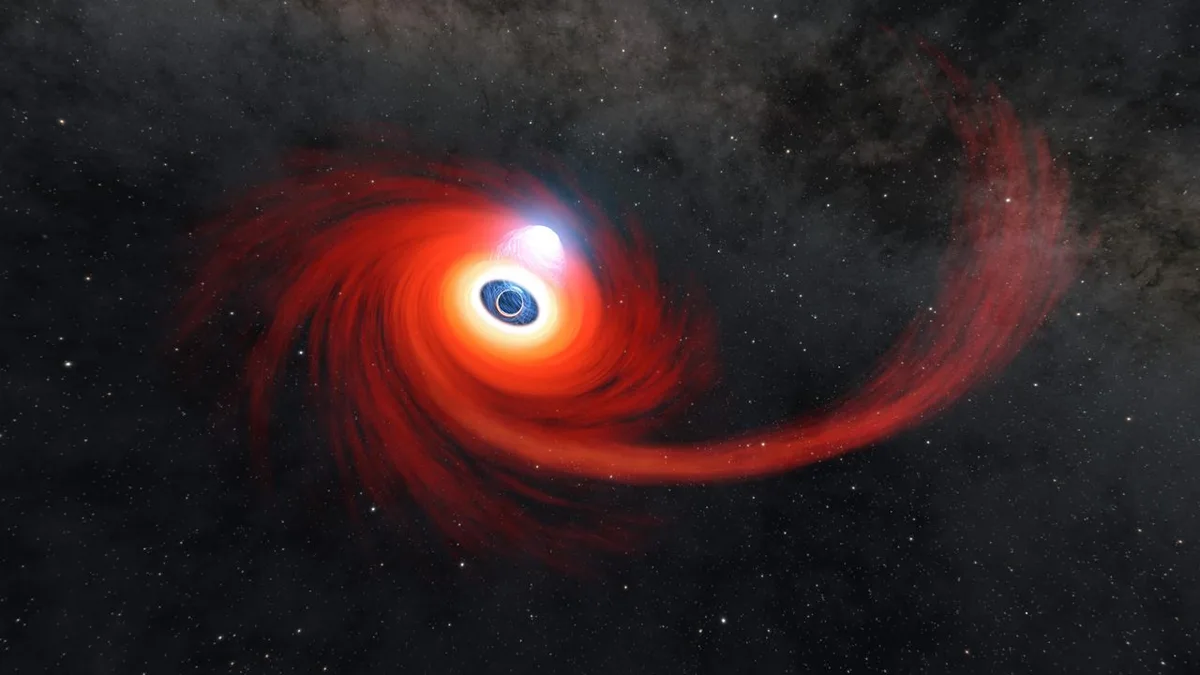
The most distant 'black hole star' yet found, existing in the universe less than 660 million years after the Big Bang, has provided a vital clue as to the origin of the mysterious "little red dots" that populate the James Webb Space Telescope's images of the early universe.
The consensus seems to be that these bizarre objects, which were first discovered in 2022, are growing supermassive black holes entombed within huge clouds of gas that have spectrums similar to cool, red stars, such as red giants .
Recently, astronomers have been finding that some of these objects are placed within the center of young galaxies whose light has been traveling for about 12 billion years, give or take a billion, to reach us.
Given their distance and faintness, black hole stars' light is difficult to disentangle from the light of a surrounding galaxy, especially when we know there is likely a galaxy there that's too faint for the JWST to resolve.
However, a newly discovered black hole star, unearthed during a JWST program called the Mirage or Miracle (MoM) survey, is acting as a kind of a missing link.
"The Mirage or Miracle survey was designed specifically to target sources considered 'risky,' meaning they could either be amazing discoveries or just interlopers, such as some cold nearby stars that look like distant galaxies," Jorryt Matthee of the Institute of Science and Technology Austria and a co-investigator on the MoM survey said in a statement.
In particular, the survey focuses on objects that look like they could be very high redshift galaxies (around a redshift of 10 or more, which equates to having existed about at least 13.1 billion years ago).
The black hole star found by the survey has been named MoM-BH*-1 and is the best example yet of a "naked" black hole star, meaning astronomers are fairly certain it exists in space on its own rather than inside a burgeoning galaxy.
This means all of its light is generated by accretion onto the black hole at the center of the cloud.
Though we cannot see this accretion because of the obscuring gas cloud, this light energizes the surrounding cloud from within, causing it to glow just as energy generated within the sun causes its outer layers to radiate.
"The spectrum we detected is our best evidence of a cloak of gas feeding an early forming black hole," Rohan Naidu of the University of Hawaii, who led the team who discovered MoM-BH*-1 and is co-leader of the MoM survey, said in the statement.
Some of the JWST's little red dot discoveries. (Image credit: NASA, ESA, CSA, STScI, Dale Kocevski (Colby College)) Intriguingly, MoM-BH*-1 lies close in space to a young galaxy at the same redshift, and estimates suggest that it will take another 100 million years for the black hole star to collide and merge with the galaxy.
5News aggregated this summary from the outlet’s public feed. The full article, with all the context, is on www.space.com — the content belongs to Space.com.