Dark matter could magnify the jets of a ravenously feeding supermassive black hole
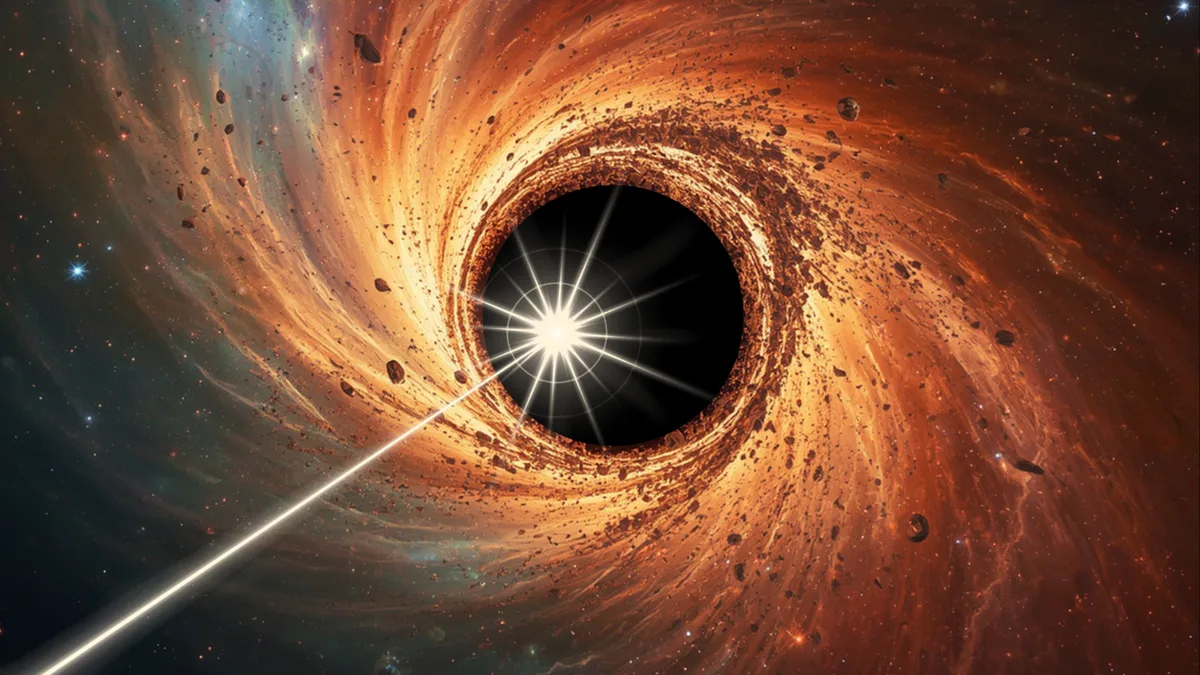
Astronomers have discovered that a jet of plasma erupting from a distant supermassive black hole at near-light-speed is being gravitationally lensed by an unseen clump of dark matter.
The discovery could tell us about the source of cosmic "ghost" particles called neutrinos.
The supermassive black hole in question is powering a type of quasar called a blazar.
All quasars involve supermassive black holes surrounded by vast quantities of material upon which the black holes feed.
Material that isn't consumed by these feasting cosmic titans is channeled to the poles of the black holes, from where it is blasted out as plasma jets.
A blazar differs from quasars in general because the jets it blasts out are directed at Earth.
Blazars, like the one central to this study, designated PKS 2233-148, have long been proposed to be the cosmic particle accelerators that blast out neutrinos.
Neutrinos get their ghostly nickname because they carry no charge and very little mass, meaning that 100 trillion of them can pass through your body every second without you noticing a thing.
This makes them hard to both detect and trace back to a source.
This gravitationally lensed blazar could assist in that hunt, finally proving blazars are filling the universe with cosmic ghosts.
"These large-scale jets are cosmic accelerators and might be generating neutrinos," Silke Britzen at the Max Planck Institute for Radio Astronomy in Germany told Phys.org.
"We study them to search for any peculiarities which might help us to gain a better understanding of neutrino emission." Blazar jet receives a cosmic course correction Astronomers have long been interested in PKS 2233-148, identifying this blazar as one that could solidify the link between neutrinos and the jets of feeding supermassive black holes.
That is because one of its polar jets is aligned along our line of sight from Earth.
Britzen and colleagues took a new look at observations of PKS 2233-148 made by the Very Long Baseline Array (VLBA) on Earth, the Fermi space telescope , which viewed the blazar in gamma rays, and the X-ray instrument aboard the Swift space observatory.
5News aggregated this summary from the outlet’s public feed. The full article, with all the context, is on www.space.com — the content belongs to Space.com.