What happens when quantum mechanics and relativity meet?

Almost a hundred years ago, physicists theorized out what free fall should do to a quantum wave.
If the solution they came up with is wrong, quantum mechanics and Einstein's theory of gravity flatly contradict each other.
But testing it has been impossible because nobody has managed to build an interferometer that could perform the necessary measurement.
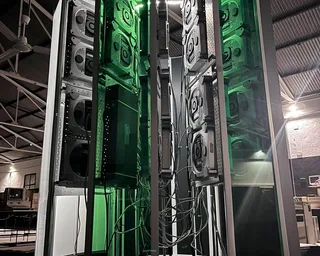
Now, a team led by Ron Folman, a physicist at Ben-Gurion University of the Negev, with collaborators in Germany, the UK, and the US, including Nobel laureate Roger Penrose, has done it.
They built a new interferometer that gives a single atom two possible paths at once: one that involves a free fall, and another where it is held perfectly still.
Both paths end at the same place at the same moment, allowing the team to measure what the fall does to a wave-like property of the atom.
Long time coming Ever since Galileo, physicists have known how to describe a falling object—where it is, how fast it goes, or how quickly it accelerates.
Quantum mechanics, though, insists that every object is also a wave.
“Every particle, doesn't matter if it's a car or a spaceship or an atom, is a wave,” Folman says.
“Everything that is a wave, like sea waves or sound waves, goes up and down.
And if you're up or down, this is measured by something called a phase.
A phase just tells you if you are at the top of the wave or at the bottom.” Read full article Comments
5News aggregated this summary from the outlet’s public feed. The full article, with all the context, is on arstechnica.com — the content belongs to Ars Technica.