Google says its AI weather model is getting better

It’s launching an updated weather model that makes forecasts based on real-time satellite observations.
It’s launching an updated weather model that makes forecasts based on real-time satellite observations.
Google is rolling out an updated AI weather model that’s supposed to be more accurate, especially when it comes to predicting rain and snowfall.
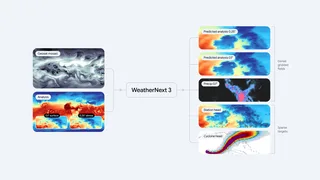
In the announcement today, the company says it’s now able to make forecasts with “unprecedented resolution” using its new WeatherNext 3 AI model. It can produce a global picture that’s five times sharper than Google’s previous model by learning from real-time weather observations, according to the company.
“One of the main developments is for [WeatherNext 3] to go beyond what data most global AI models train on,” says Samier Merchant, a research engineer at Google Research. “We’re able to leverage fresher and richer observational data sets.”
Weather forecasting has traditionally relied primarily on supercomputers that simulate the physics of the atmosphere. That involves solving complex equations, and ultimately comes with a time-lag. AI weather models created by Google and other developers, in contrast, can make faster predictions by recognizing patterns in historical weather data.
Google is going a step further by incorporating live satellite data in its new model. WeatherNext 3 is able to produce a forecast each hour based on the most recent satellite observations. That allows for faster predictions than its previous AI models, as well as higher spatial and temporal resolution.
For comparison, the previous model, WeatherNext 2, produced forecasts every 6 hours on a 25-kilometer grid. The newer model can visualize certain variables, including temperature and moisture, at up to a 5-kilometer resolution.
That speed and resolution is particularly helpful when it comes to predicting rain and snow stemming from fast-moving weather systems, Google says. Using satellite data to make predictions also fills in gaps left in locations where there are fewer rain gauges on the ground. These are places — primarily outside of the US and Europe — where Google says WeatherNext 3 can provide the biggest improvements to weather forecasts. Google says users will see precipitation forecasts that are up to 50 percent more accurate when looking at least a day in advance.
Google also designed its latest AI weather model to produce forecasts for renewable energy generation. That includes predictions on wind speed at 100 meters, for example, at about the height of a turbine. Google, like other tech companies developing generative AI tools, is demanding more energy for data centers.
“As the energy needs of Google, but [also] entire humanity, is increasing its energy needs, to make sure that we make renewable a very appealing opportunity is very important for us,” Ferran Alet, a research scientist at Google DeepMind tells The Verge .
WeatherNext 3 is now incorporated into Search, Maps, Gemini, and other Google products.
5News aggregated this summary from the outlet’s public feed. The full article, with all the context, is on www.theverge.com — the content belongs to The Verge.