How do you rebuild trust in the government? One pothole at a time.
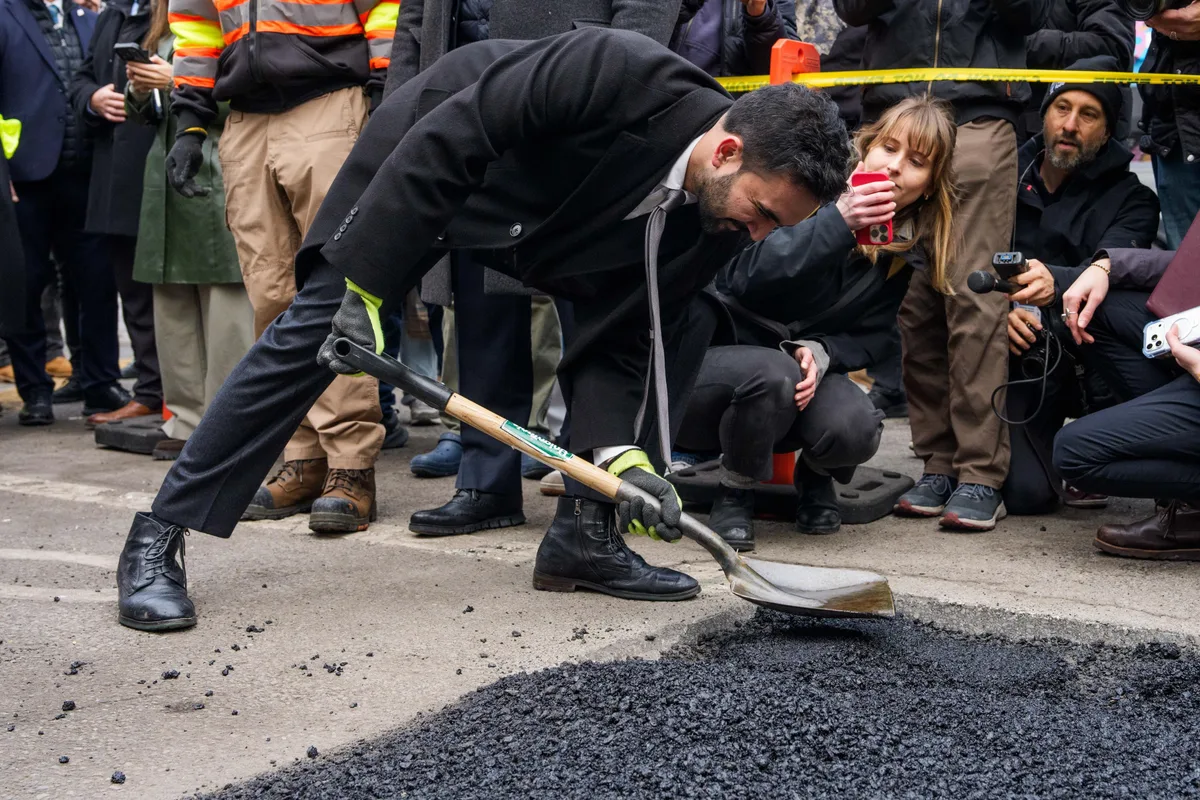
Symbolic urbanism is having a moment, especially this summer in New York City, where the air is far too humid, but the potholes increasingly get filled. | Adam Gray/Bloomberg via Getty Images “If this is democratic socialism,” wrote one New Yorker under a mayoral Facebook post, “maybe it is the change we need.” She was referring neither to Mayor Zohran Mamdani’s heavily scrutinized plan for city-run grocery stores , nor to his pied-à-terre tax on the rich, nor even to his trademark — though thus far, unrealized — vision for fast, free buses and universal childcare .
No, she was talking about candy-colored scaffolding .
The mayor recently made good on his plan to give a facelift to the city’s ubiquitous scaffolding, that odiously ugly green eyesore that envelops hundreds of miles of New York City sidewalks.
Another New Yorker posted on TikTok complaining about a smattering of potholes on his street.
By the time he got home from work, they had all been filled , setting off a maelstrom of viral requests, including one from a dateless Brooklynite looking for love : “Zohran, what are you gonna do to fix this?” (The mayor cheekily obliged with a list of local meet-cute spots.) Symbolic urbanism is having a moment, especially this summer in New York City, where the air is far too humid, but the potholes increasingly get filled, sometimes personally by the internet’s favorite millennial mayor himself.
Mamdani’s embrace of what he calls “pothole politics” — a shrewd modern-day twist on the “sewer socialism” that once propelled some 20th-century leftists into office — has delighted and exhilarated New Yorkers who’ve long yearned for a City Hall that heeded their most mundane municipal calls over a scorching-hot subway station or a sidewalk full of cracks.
With a smile plastered on his face, Mamdani has, in fact, filled potholes at a faster rate than any New York City mayor in years.
In cities where everything seems to take forever to build, literally covering over these sites of everyday urban friction has become a powerfully visible form of political currency.
View Link “There’s just this thirst for competence right now,” Don Moynihan, a professor of public policy at the University of Michigan, told me, and Mamdani in particular has “brought a sense of joy and fun to the nuts and bolts of public administration.” It may even be enough to help restore some of the public trust needed for the more arduous, less palatable work involved in making our cities more liveable in the long run.
5News aggregated this summary from the outlet’s public feed. The full article, with all the context, is on www.vox.com — the content belongs to Vox.