What happens when a galaxy's supermassive black hole turns off? These dying radio galaxies could show us
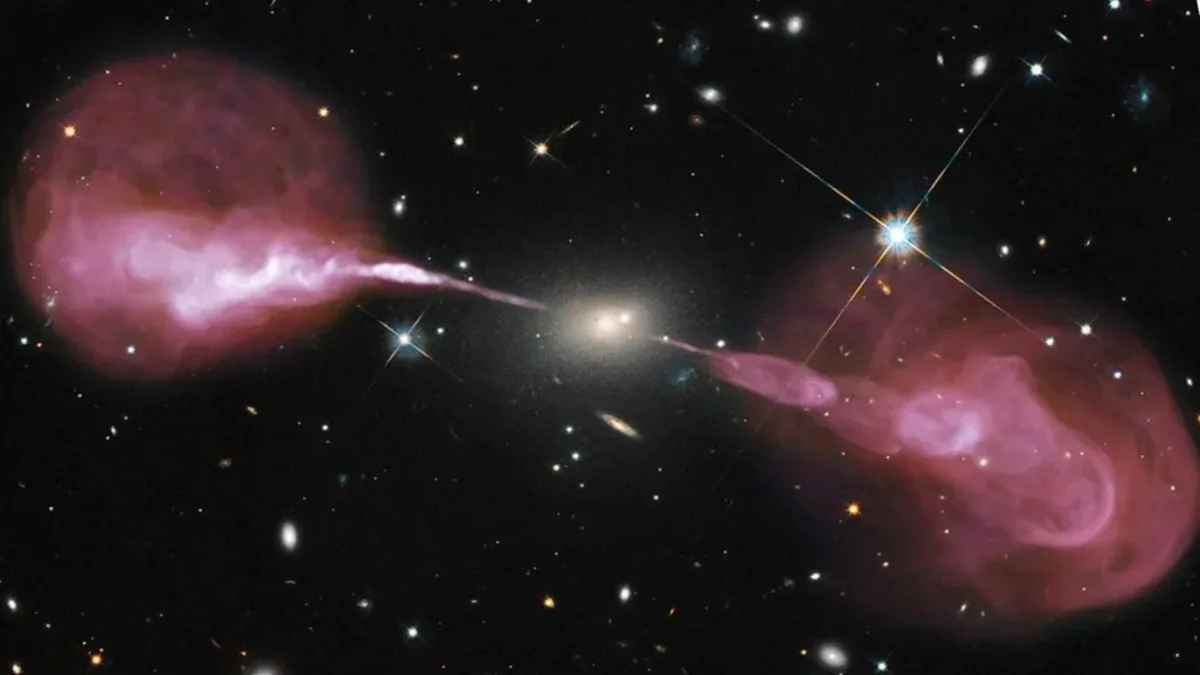
Astronomers have discovered a hitherto unseen population of so-called "radio galaxies" with fading "radio lobes." The discovery reveals what happens when the supermassive black hole engines that power these vast, blooming outflows of plasma stall.
This discovery increases our understanding of the life cycles of galaxies.
The team behind this research studied 14 candidates for faded or remnant radio galaxies found in a region of the sky over Earth, studied intensely by the XMM-Newton X-ray spacecraft, called the XMM–Newton Large-Scale Structure (XMM–LSS) field.
Radio galaxies are extremely bright in radio waves and feature vast lobes of gas that can stretch out for millions of light-years.
Remnant radio galaxies represent the final stage in the evolution of radio galaxies, at which point the jets from the galaxies' central regions, or active galactic nuclei (AGNs) powered by feeding supermassive black holes , have switched off.
Therefore, these jets can no longer replenish the vast radio lobes, causing them to gradually fade.
The researchers studied the XMM–LSS field using the MeerKAT radio telescope , an array of 64 antennas located in the desert-like region of the Northern Cape, South Africa, the Jansky Very Large Array , and the LOFAR (Low-Frequency Array) network.
This powerful combination of observations allowed them to study how radio emissions from the lobes of radio galaxies change as the particles within them "age" and lose energy.
This allowed the researchers to determine that 12 of the 14 candidates actually are remnant radio galaxies, while the other two remain active radio galaxies.
The team also discovered something striking about the 12 confirmed radio galaxy remnants.
Two examples of the newly discovered giant radio galaxies, each spanning millions of light-years. (Image credit: Pal, et al (2025)) One thing that really stood out in this study was the ages of these remnants, which appeared to have been fading for between 8 million and 42 million years, with the average "fade age" being 12 million years.
This age is younger than the ages measured for radio galaxy remnants, which could indicate that astronomers have been missing a population of short-lived remnants.
This wasn't the only extraordinary finding in this study.
The scientists also found that the remnants they looked at exist in a wide range of evolutionary stages, with some having jets that have only just switched off, while others are more evolved, having "powered down" long ago.
5News aggregated this summary from the outlet’s public feed. The full article, with all the context, is on www.space.com — the content belongs to Space.com.