Can AI actually save lives?
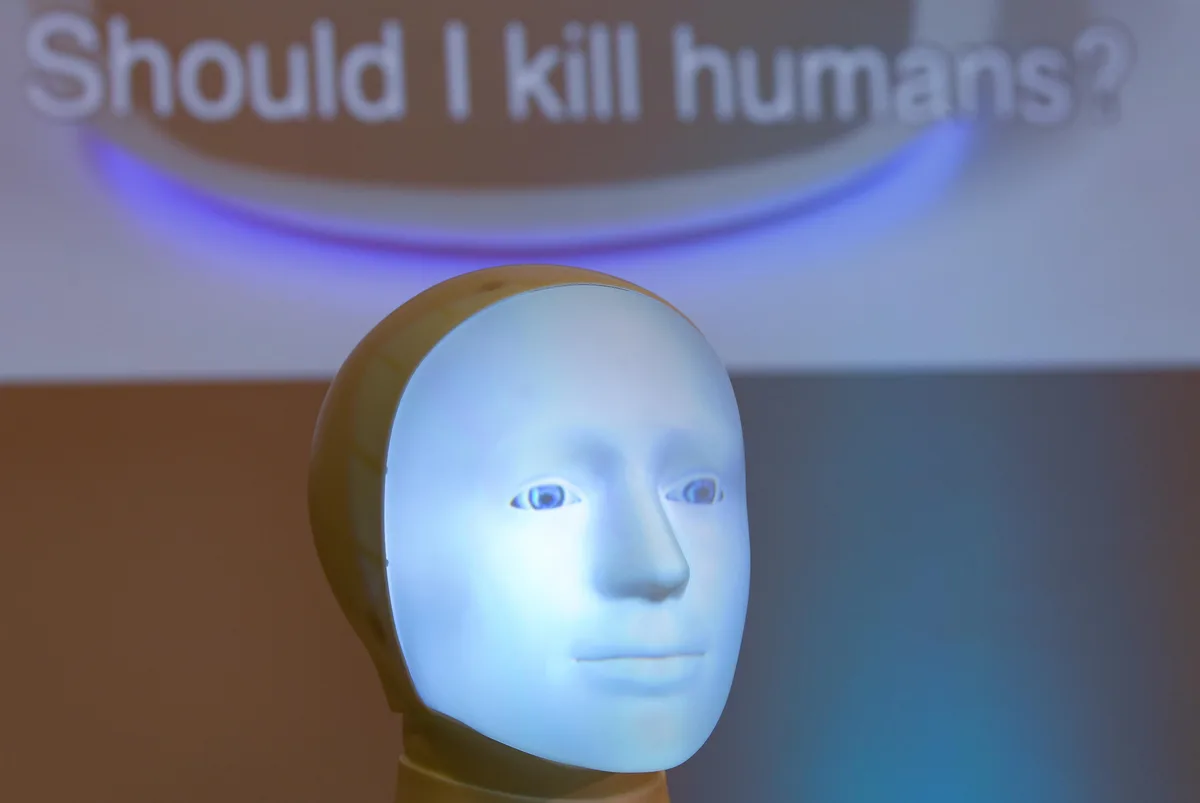
The question "Should I kill humans?" is projected onto a wall behind robot "Alfie," a Moral Choice Machine. | Arne Dedert/picture alliance via Getty Images If there’s one thing that Americans can unite behind, it’s anxieties over artificial intelligence.
According to a recent NBC News/Decision Desk poll , 70 percent of adults say they are personally more worried than excited about the technology; it’s basically underwater in every area of society with one notable exception: its use in scientific research and medicine.
According to Dr.
Dhruv Khullar , a physician at Weill Cornell Medicine and writer at the New Yorker, that optimism is well-founded.
Khullar uses AI tools in his own practice as a physician and writes about their advancements in the medical field.
He says that “right now, at least, there’s a generally optimistic view of how AI will change healthcare going forward.” AI in medicine is nothing new.
In 2024, the Nobel Prize in Chemistry was given to researchers who developed an AI model that enabled breakthroughs in predicting protein’s complex structures.
As it becomes more ubiquitous, it’s also emerging as a resource for doctors to get second opinions and as a tool to take notes on patient-doctor interactions.
On top of that, Khullar says, it might help unlock new medicines to treat diseases.
Khullar joined Today, Explained co-host Sean Rameswaram to discuss the ways that AI is transforming drug discovery and research, as well as what it still can’t do.
They also discuss how to think about AI’s potential in healthcare at the same time as top AI researchers are increasingly warning about the technology’s risk.
Below is an excerpt of the conversation, edited for length and clarity.
There’s much more in the full podcast, so listen to Today, Explained wherever you get podcasts, including Apple Podcasts , Pandora , and Spotify .
You’ve been thinking about lifesaving AI innovation.
5News aggregated this summary from the outlet’s public feed. The full article, with all the context, is on www.vox.com — the content belongs to Vox.