On this day in space! Aug. 30, 1992: Astronomers discover 1st Kuiper Belt object out beyond Pluto
On Aug.
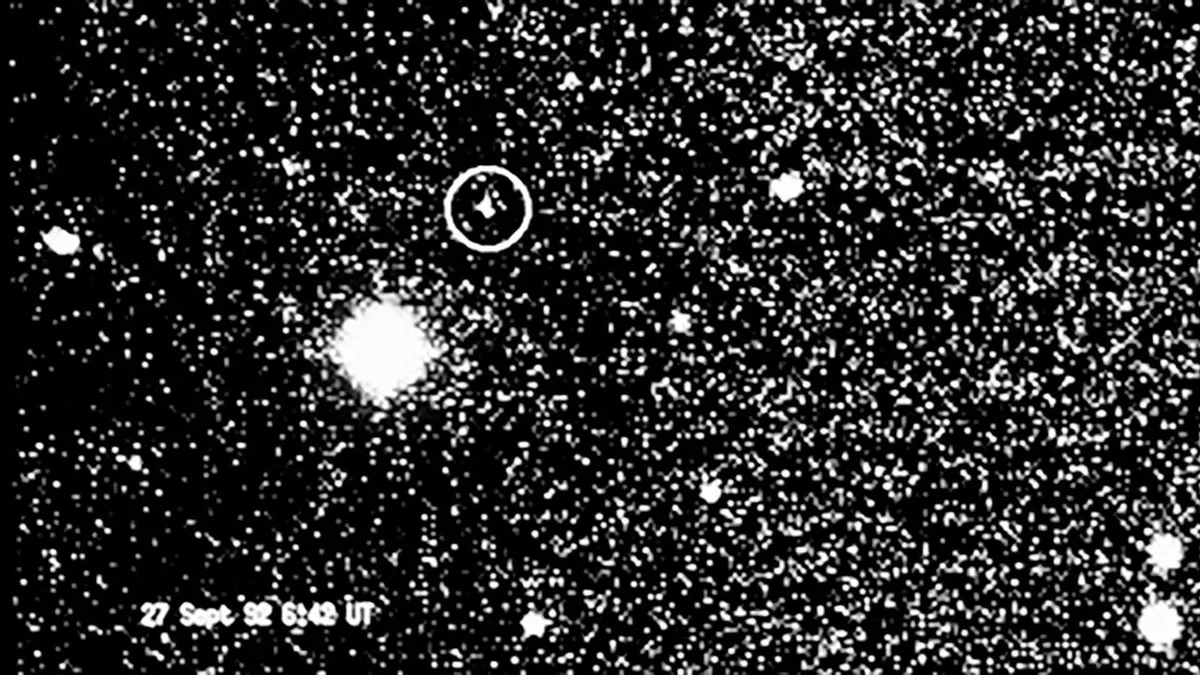
30, 1992, astronomers spotted an object orbiting the sun beyond Pluto for the very first time.
It was the first Kuiper Belt object ever detected.
Before then, Pluto was believed to be the most distant planetary body of our solar system .
No one had seen anything orbiting farther out because these so-called Trans-Neptunian objects were far too faint to detect with the technology they had at the time.
With new digital imaging techniques, astronomers were able to spot a new and tiny world orbiting 4 billion miles beyond Neptune .
Officially designated 1992 QB1, this 100-mile-wide (160 kilometers) object was thousands of times fainter than Pluto.
Now astronomers have confirmed more than 2,000 objects orbiting out there in what is now known as the Kuiper Belt.
Why it mattered This image shows a European Southern Observatory view of 1992 QB1, the first Kuiper Belt Object, discovered on Aug.
30, 1992. (Image credit: European Southern Observatory) Our solar system was a much smaller place before the discovery of 1992 QB-1.
We had nine planets, from Mercury to Pluto, and that was the end.
But when astronomers found 1992 QB-1, it led to a much larger solar system than anyone could have dreamed.
The Kuiper Belt, named after the Dutch astronomer Gerard Kuiper who first proposed its existence, is a doughnut-shaped region that begins at the orbit of Neptune, about 2.8 billion miles (4.6 billion miles) from the sun.
If you use the distance between the Earth and sun, which is 93 million miles (1 astronomical unit or 1 AU), as a guide, the Kuiper Belt begins about 30 AU from the sun and extends out to 1,000 AU.
5News aggregated this summary from the outlet’s public feed. The full article, with all the context, is on www.space.com — the content belongs to Space.com.