On this day in space! Aug. 11, 1960: 1st object successfully recovered from orbit
On Aug.
11, 1960, part of the Discoverer 13 satellite became the first human-made object to be recovered from Earth's orbit.
The United States Department of Defense launched the mission as part of the C.I.A.'s Corona spy satellite program.
They wanted to see if they could return a satellite's instrument package to Earth safely and gently enough to retrieve the object intact.
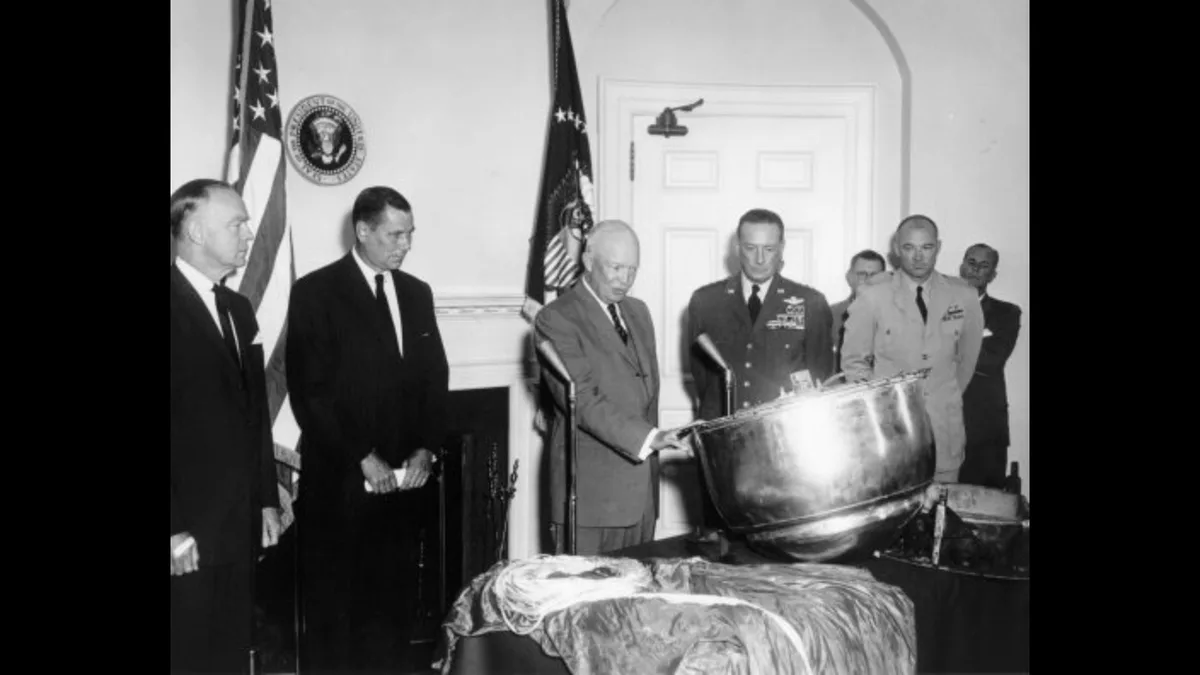
The reentry capsule was a big, bowl-shaped hunk of metal that weighed about 120 pounds and contained only an American flag.
After deploying a heat shield and parachute, the capsule splashed down in the Pacific Ocean.
A Navy helicopter pulled it out of the water and airlifted it to a ship, which brought it back to Pearl Harbor.
President Eisenhower inspects the capsule from Discoverer 13. (Image credit: By Dwight D.
Eisenhower Library, Public Domain) Why it mattered This first paved the way for modern spaceflight.
We might take it for granted today as we see rocket stages return to Earth and land with the grace of a rehearsed dance and astronauts go back and forth to the International Space Station .
At this point, all variety of capsules and spacecraft have not only gone out into space, but returned.
But if we travel back to 1960, this was a groundbreaking feat.
Discoverer 13 was a reconnaissance satellite (or what we might call a spy satellite) built by General Electric that launched with no cameras or film on board (subsequent satellites in the series, starting with Discoverer 14, had cameras).
Instead, it carried diagnostic instruments and flew 17 times around our planet before reentering our atmosphere, deploying a small parachute and splashing down in the Pacific Ocean where it was retrieved by the U.S.
5News aggregated this summary from the outlet’s public feed. The full article, with all the context, is on www.space.com — the content belongs to Space.com.