Volkswagen’s crazy-efficient EV borrows an idea from Slate
Disrupt 2026: OpenAI, Anthropic, Replit, and more take over 6 industry stages. 25% off tickets now
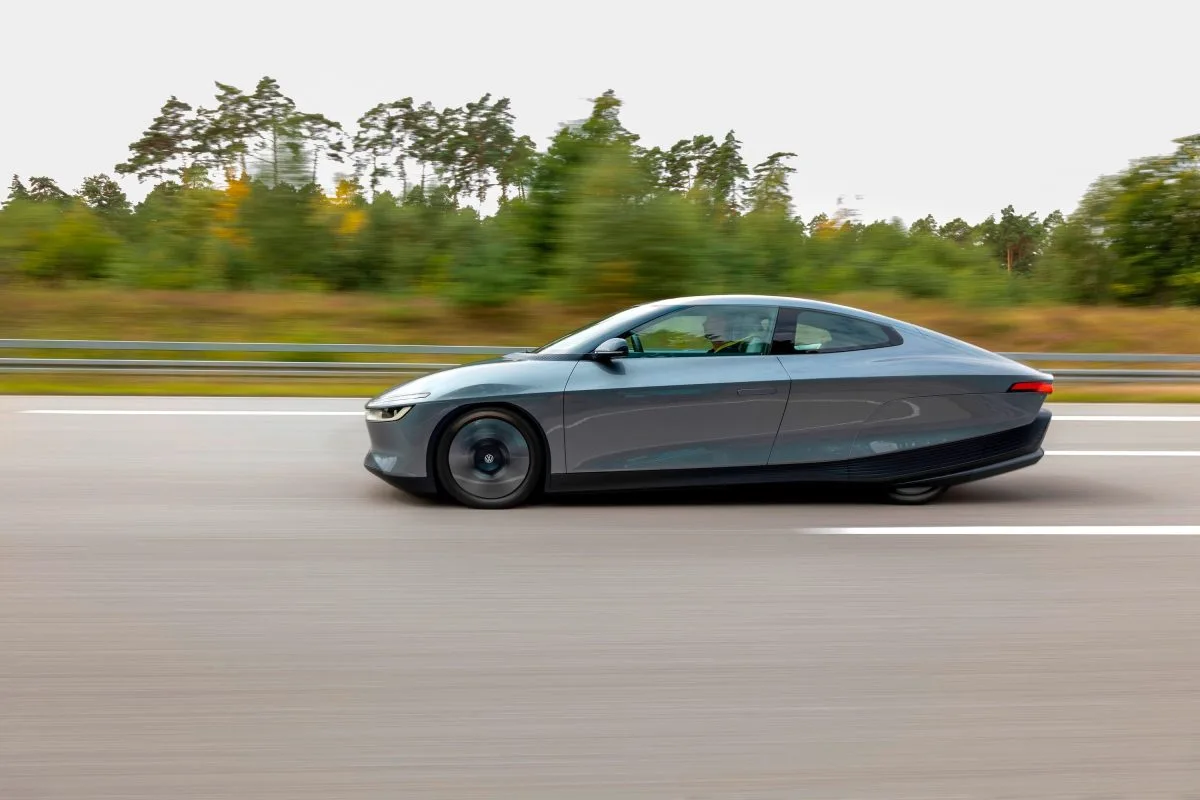
Volkswagen took the covers off a new prototype electric vehicle Monday, one that’s capable of hitting the equivalent of 323 miles per gallon under ideal conditions, making it one of the most efficient cars in the world.
It’s not unusual for automakers to float pie-in-the-sky concepts with outlandish stats, but Volkswagen took it a step or two further by building the EV and driving it from its home base in Wolfsburg, Germany, on a 794-mile (1,278-kilometer) trip to Vienna. The team charged the Mission Efficiency prototype once during the journey and arrived with 104 miles (168 kilometers) of range left, resulting in consumption of 7.51 kilowatt-hours per 100 miles, or about 279 MPGe.
The teardrop-shaped Mission Efficiency prototype was built using the electric motor and battery from the ID. Polo, two features that bring the car to “near production” status, Volkswagen said in a press release .
For those keeping score, the prototype is almost twice as efficient as the most efficient production car in the world, the Lucid Air Pure.
By some back-of-the-envelope math, Volkswagen’s science experiment can get more than 400 miles of range out of a 54.9-kilowatt-hour battery, though that’s not an official EPA rating. Lucid gets 420 miles from an 84-kilowatt-hour battery per EPA ratings, but it’s a much larger and more practical vehicle.
The most noticeable is the roofline, which tapers quickly after peaking above the driver’s head. The shape, known as a Kammback, is among the most aerodynamic shapes a vehicle can take. Volkswagen was able to bring the coefficient of drag down to 0.158, while also keeping the frontal area low at just 2.08 square meters.
As a result, the Mission Efficiency is technically a 2+2, meaning the rear seats aren’t suitable for most adults. Volkswagen said the backseat is designed for people shorter than 5-foot 3 inches, or about 1.6 meters.
“The prototype was designed so that it could theoretically be used by a young family of four,” Volkswagen said, though anyone who has contemplated sitting in a 2+2 knows that even kids might scoff at the notion.
Another compromise sits closer to the road. Because wheels and tires can contribute about a quarter to a third of aerodynamic drag, the designers tightened the space between the wheel arches and the front tires. It’s great for efficiency, but probably not great for ride quality since wheels need space to move inside the wheel wells so the shocks can absorb bumps.
One place Volkswagen didn’t compromise was the mirrors. Sideview mirrors generate a lot of drag just by hanging off the sides, and while cameras would have cut into those losses significantly, they don’t offer the same sense of depth that true mirrors do.
To top it all off, Volkswagen put solar cells on the roof and the trunk lid. It’s a nice touch that’s sure to delight the internet, but their impact is limited, adding just 18 miles (30 kilometers) to perfectly flat, sunny routes driven at a constant 42.25 mph (68 kph).
Inside, the seats are built using lightweight materials and designs.
5News aggregated this summary from the outlet’s public feed. The full article, with all the context, is on techcrunch.com — the content belongs to TechCrunch.